· By Erin Walsh, Canine Enrichment Trainer
What Is a Snuffle Mat? A Plain-English Guide
I run enrichment sessions for dogs of every age and temperament, and the snuffle mat is the one tool I hand to almost every owner in their first week. People often expect something high-tech. What they get is a soft square of fleece that looks a little like a shaggy flower, and their first reaction is usually a polite kind of doubt. That doubt disappears the moment they sprinkle in a handful of kibble and watch their dog get to work.
This guide answers the question at face value. I will explain exactly what a snuffle mat is, where the idea came from, what happens in a dog's nose and brain while it forages, which dogs get the most out of one, and how long a typical session actually lasts. No sales pitch in the first breath, just the plain mechanics of a very simple object.
The short definition
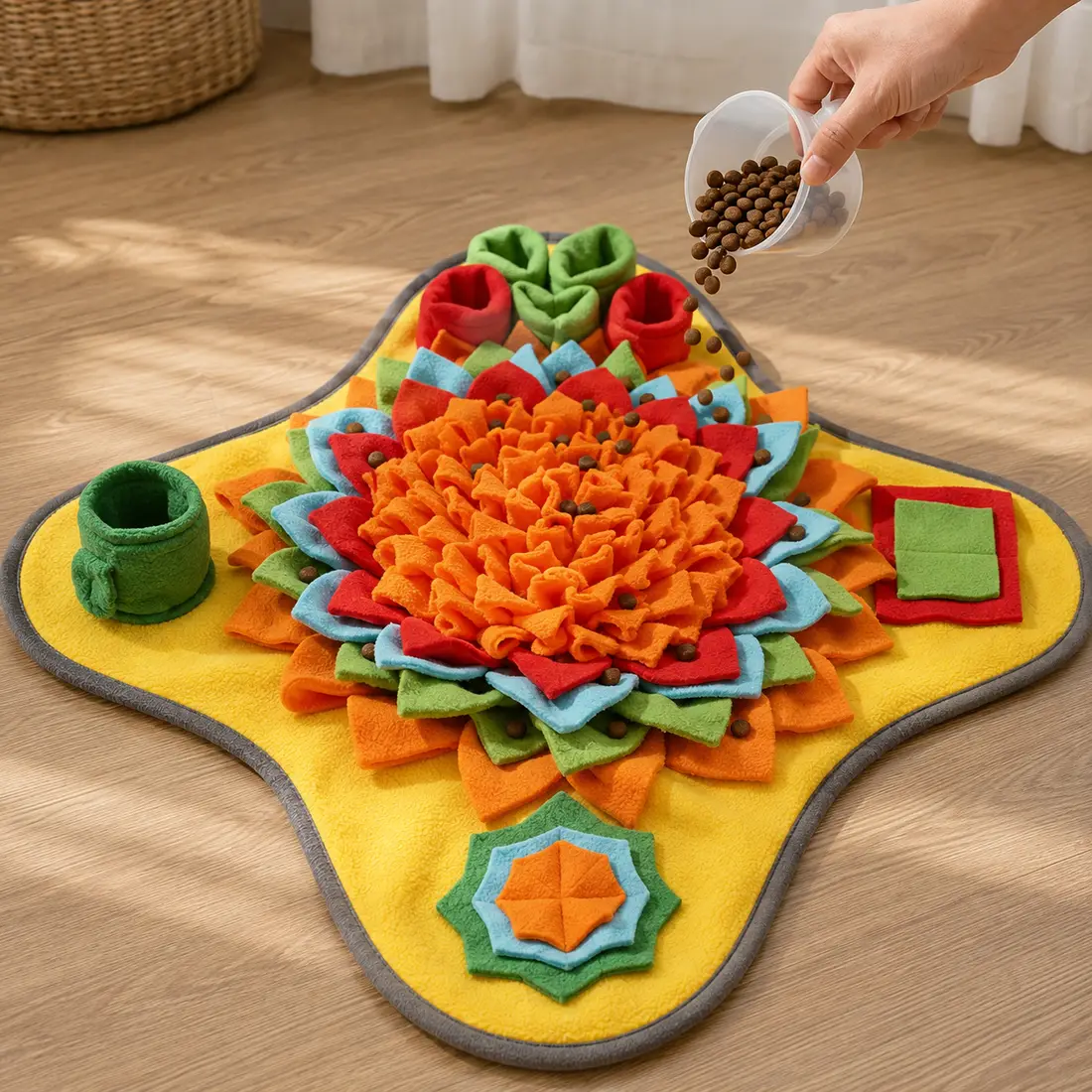
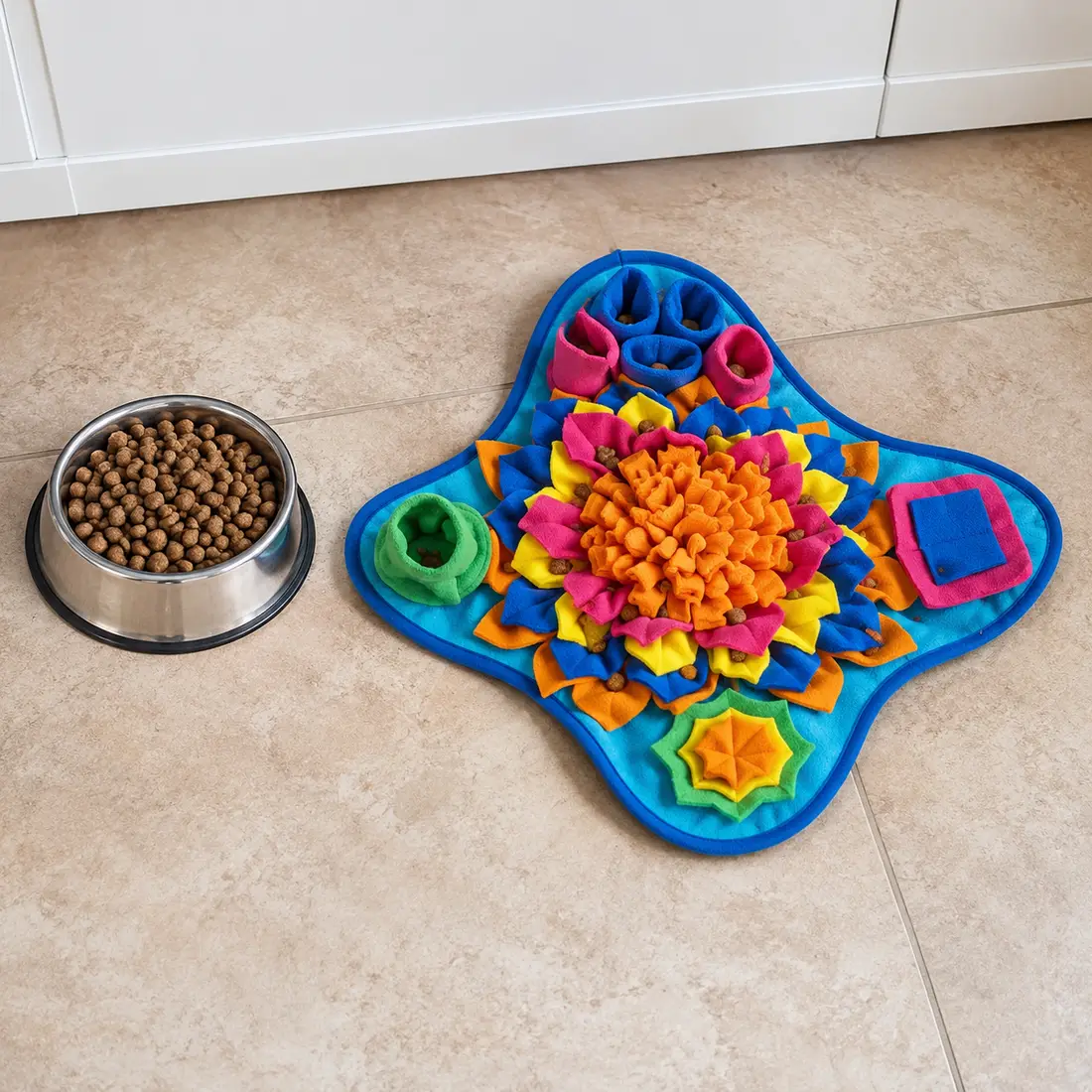
Picture a fleece rug about the size of a large placemat. Hundreds of fleece strips are knotted through a gridded base until the surface is thick, folded and full of hiding places. You scatter dry food or small treats down into that fabric, set the mat on the floor, and your dog searches it out piece by piece using its nose. That is the whole idea, and its simplicity is the point.
The mat I keep recommending measures roughly nineteen inches on each side and is built from soft shaker fleece, which is dense enough to hold food deep in the folds without letting it fall straight through. Because there is no plastic tray, no motor and no battery, there is very little that can break or go wrong. A dog with a working nose and a bit of appetite is all the equipment you need on the other end.
Where snuffle mats came from
Snuffle mats grew out of the wider world of canine enrichment, the practice of giving captive and companion animals outlets for their natural behaviors. Zoos have used foraging setups for decades to keep big cats and bears occupied, and dog trainers borrowed the same principle. Instead of feeding an animal from a bowl in ten seconds, you spread the food out and let the animal use its species-typical skills to find it.
For dogs, the species-typical skill is scent. Formal nose-work and scent detection classes were already popular by the 2010s, and the snuffle mat is essentially a home version of that activity, stripped down to something anyone can use on a kitchen floor. The reason it caught on is that it delivers the mental payoff of a training class without the class. You are letting the dog do the one thing it is built to do better than almost any other animal, which is to smell.
olfactory receptors in a dog's nose, versus about 6 million in a person's, which is why sniffing is such rich work for a dog
How a snuffle mat works
When you hide kibble in the fleece, you set a problem the dog can only solve with its nose. The dog cannot see the food buried in the folds, so it lowers its head, breathes in short sniffs, and follows the scent gradient to each piece. That deliberate, methodical sniffing is the active ingredient. It is slow, focused and surprisingly tiring, which is why a five-minute forage can leave a dog as settled as a longer walk.
There is a calming side to this as well. Sniffing is a self-directed activity, and dogs seem to find it genuinely satisfying rather than merely busy. Researchers have measured this by letting dogs play scent games and then testing their outlook on the world, and the results point the same way that trainers have long suspected.
of regular nose-work games left pet dogs measurably more optimistic on a cognitive bias test, a recognized marker of better welfare
— Duranton & Horowitz, Applied Animal Behaviour Science, vol. 211, 2019
The mat also paces the meal. A dog that would inhale a bowl of food in under a minute has to slow down to pick each piece out of the fabric, which is the same reason people reach for slow-feeder bowls. A snuffle mat simply adds the scent puzzle on top of the pacing. If you want the deeper look at benefits and what it covers, I cover them in are snuffle mats good for dogs.
Which dogs are snuffle mats for?
The short answer is almost all of them, because scent is universal to the species. That said, some dogs get an outsized benefit. Below is how I sort them when an owner asks whether a mat is worth trying.
| Type of dog | Why a snuffle mat helps |
|---|---|
| High-energy adults | Gives a mental workout on days when a long walk is not possible |
| Fast eaters | Slows the meal down and spreads it across several minutes |
| Senior dogs | Low-impact activity that works the mind without stressing joints |
| Anxious or over-aroused dogs | Sniffing is self-soothing and helps a wound-up dog settle |
| Puppies | An early, gentle outlet for the nose and a first taste of problem-solving |
| Bored or crated dogs | Turns rainy days and downtime into something to do |
The first and last rows deserve notes of their own, since a very young dog and a very old one both need the setup adjusted rather than the standard one. I keep a dedicated walk-through on the snuffle mat for puppies page, and the changes that matter for an older dog, hiding depth, mat placement and session length, are in snuffle mats for puppies and senior dogs. If you want a broader menu of activities the mat sits inside, the dog enrichment ideas guide lays out a dozen of them.
How long does a session last?
A typical snuffle session runs about ten to twenty minutes, though the timing depends far more on how you load the mat than on the dog. Scatter a light handful of kibble on top and an eager dog will clear it in five. Press food down deep into the folds, use a mix of sizes, and tuck a few pieces into the corner pockets, and you can stretch the same amount of food into a genuinely absorbing session.
I usually tell owners to feed one full meal a day on the mat rather than treating it as an extra. That way the enrichment costs no additional calories, and the dog earns its dinner instead of gulping it. Once the mat is empty, most dogs will double-check it a few times and then flop down, which is exactly the calm you are aiming for. To get the loading technique right, and to understand why a store-bought mat holds food better than a flat homemade one, see how to make a snuffle mat.
Common questions
Is a snuffle mat just a slow feeder?
It slows eating, but it does more than a plastic slow-feeder bowl. The bowl only makes the food awkward to reach. A snuffle mat asks the dog to search by scent, so it adds real mental work on top of pacing the meal. That extra layer is what tires a dog out.
Can I feed a whole meal on a snuffle mat?
Yes, and many owners do. Scatter a full portion of kibble into the fleece and let the dog forage it out instead of eating from a bowl. When you are starting out, use part of a meal so your dog learns the game without getting frustrated, then build up to the full portion.
Do snuffle mats work for cats?
They do. Cats forage by scent as well and often take to a mat with dry food or freeze-dried treats, though the pieces usually need to be smaller than they would be for a dog. Any confident nose-led animal can play the game.
If you are weighing your options, our best snuffle mat guide compares sizes and builds, and you can read verified owner feedback on the reviews page.
Machine washable · Free shipping · 30-day guarantee