How to choose the best snuffle mat for dogs
Snuffle mats look simple, and that is part of the appeal. Underneath, though, a few practical details decide whether your dog gets minutes of happy foraging or loses interest in thirty seconds. This guide walks through the criteria that actually matter, compares fabric mats with the other enrichment styles you will see, and shows where the Sniffgrove snuffle mat lands against each point.
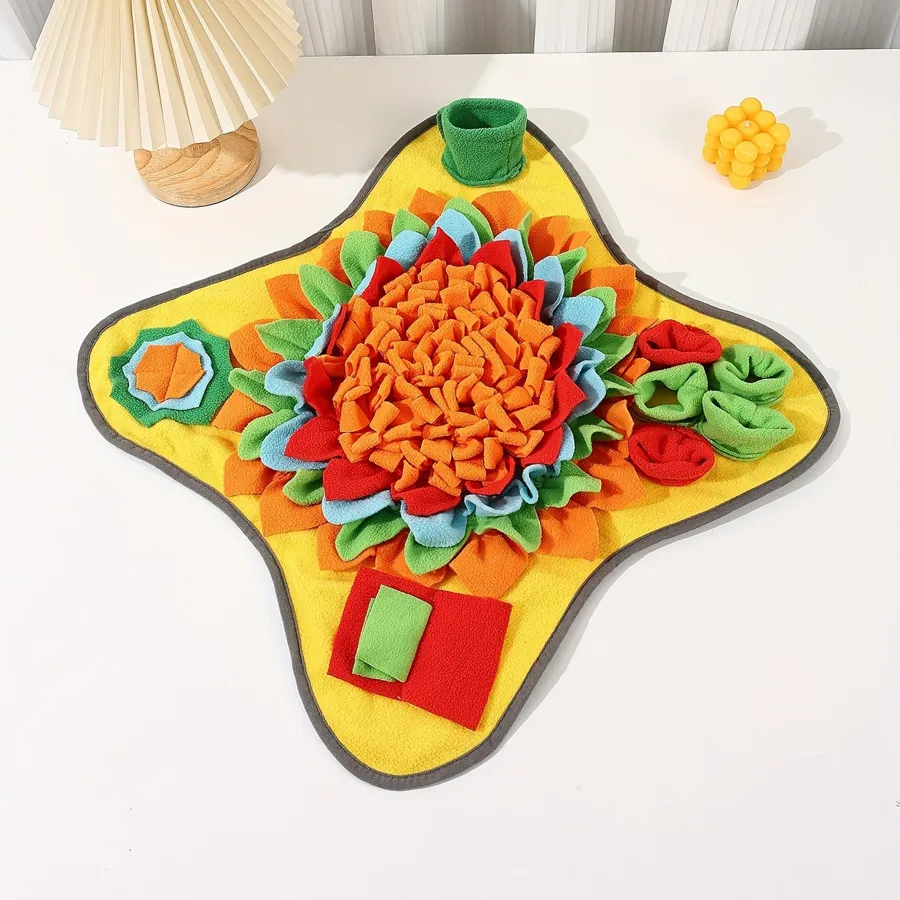
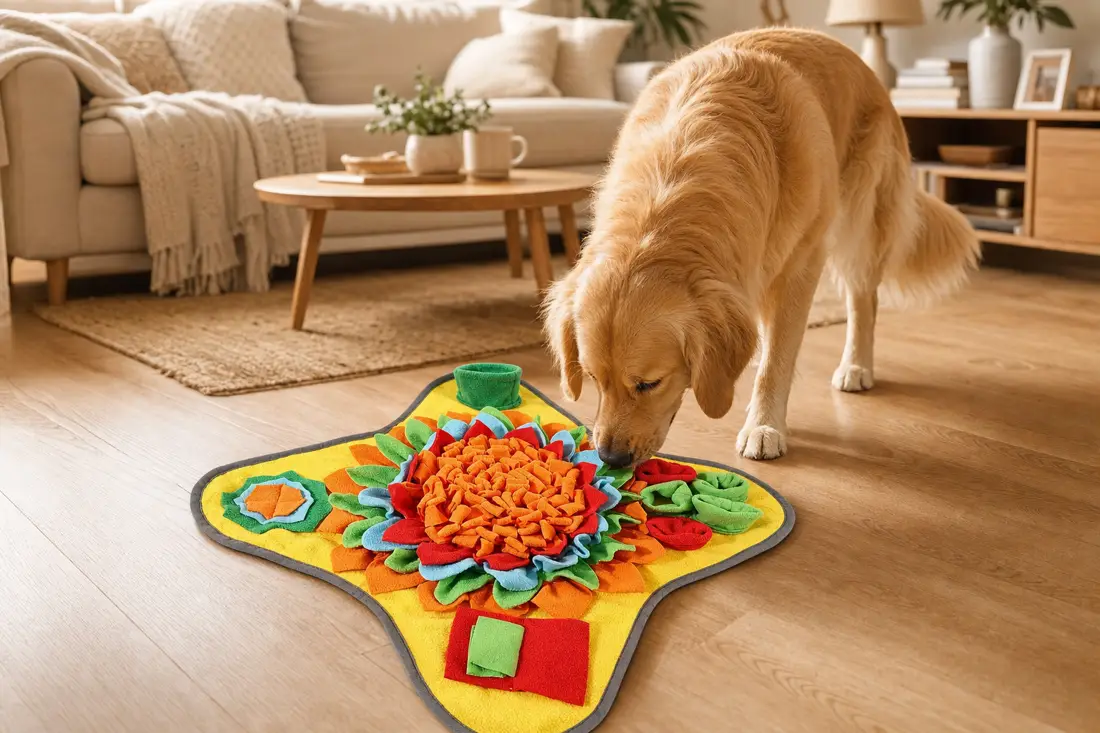
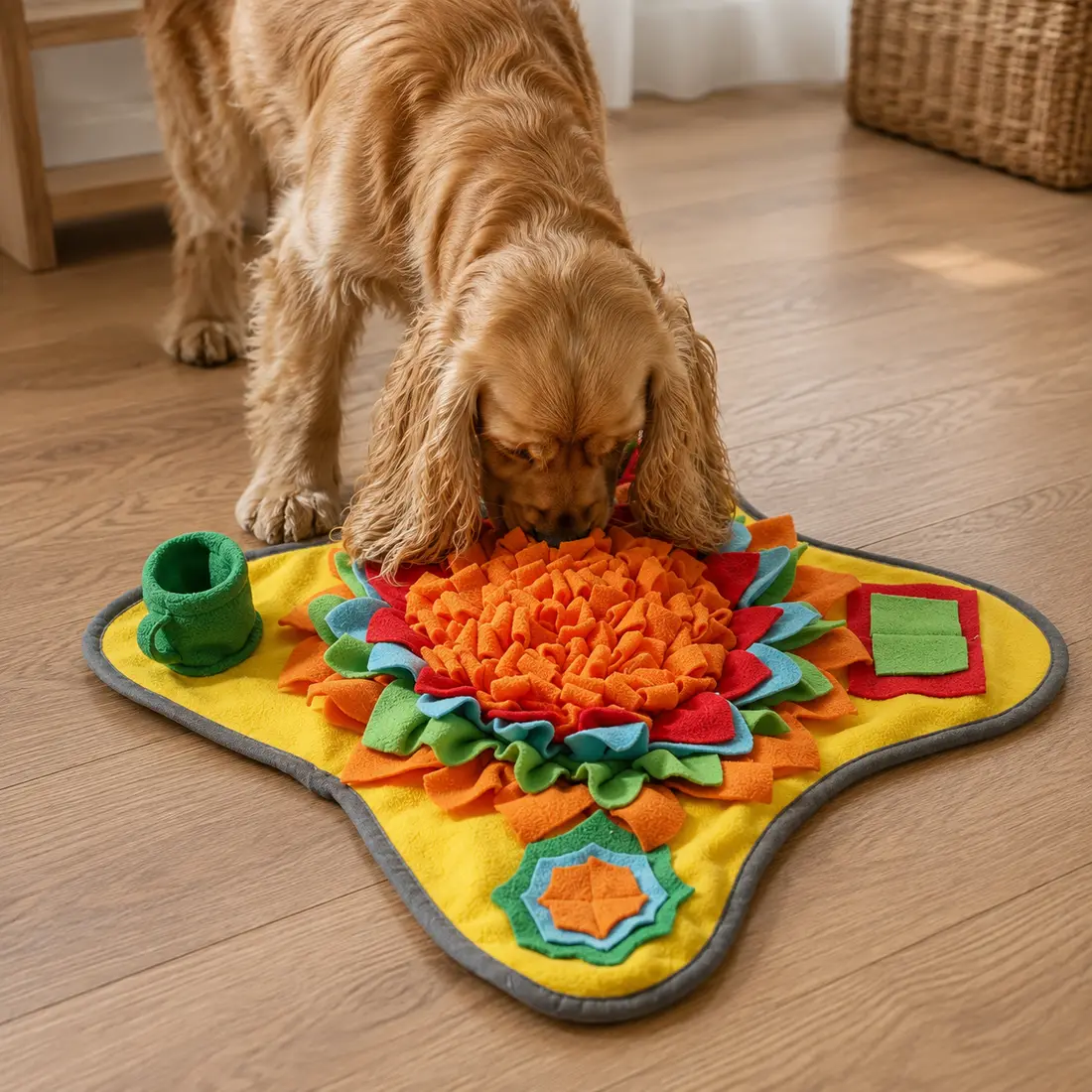
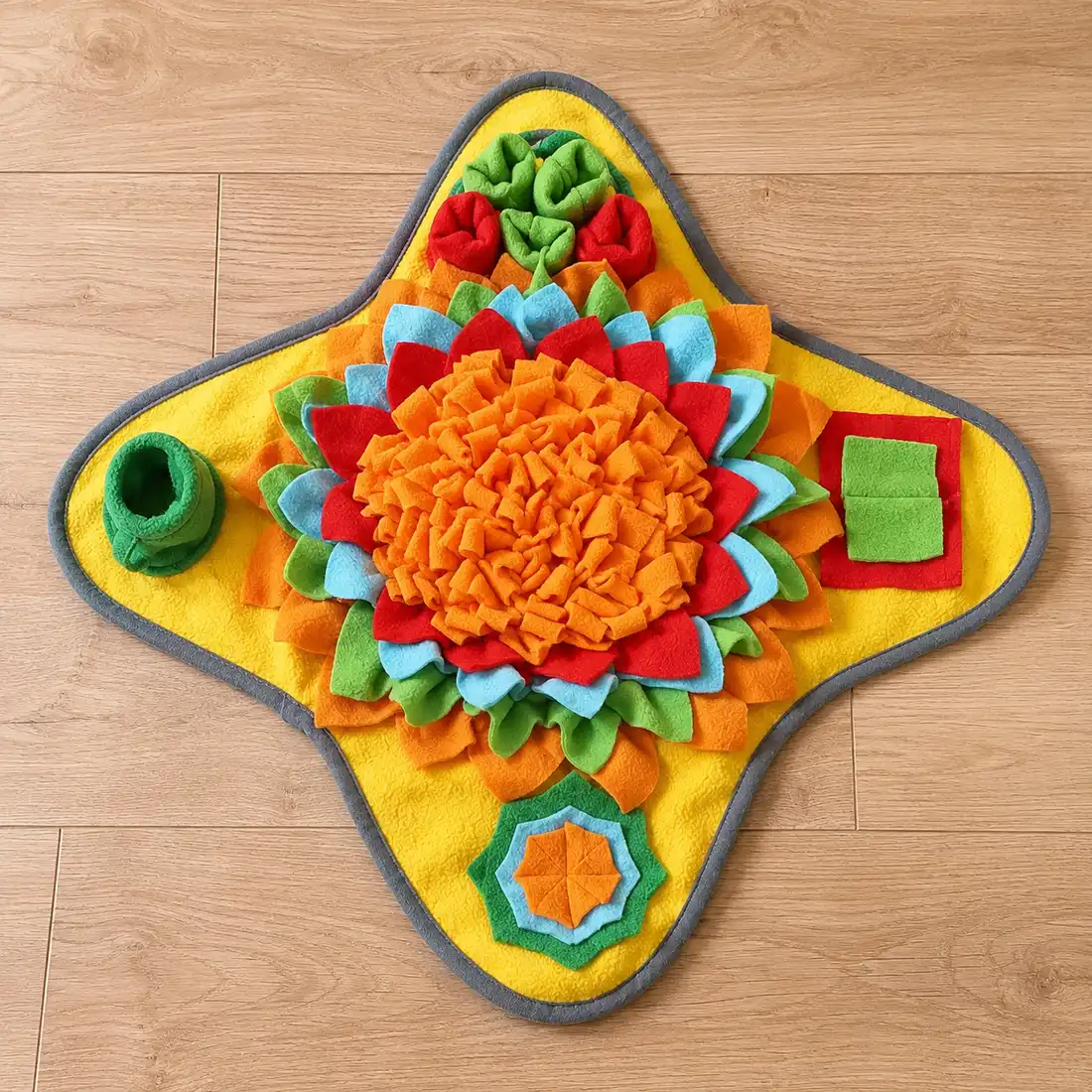
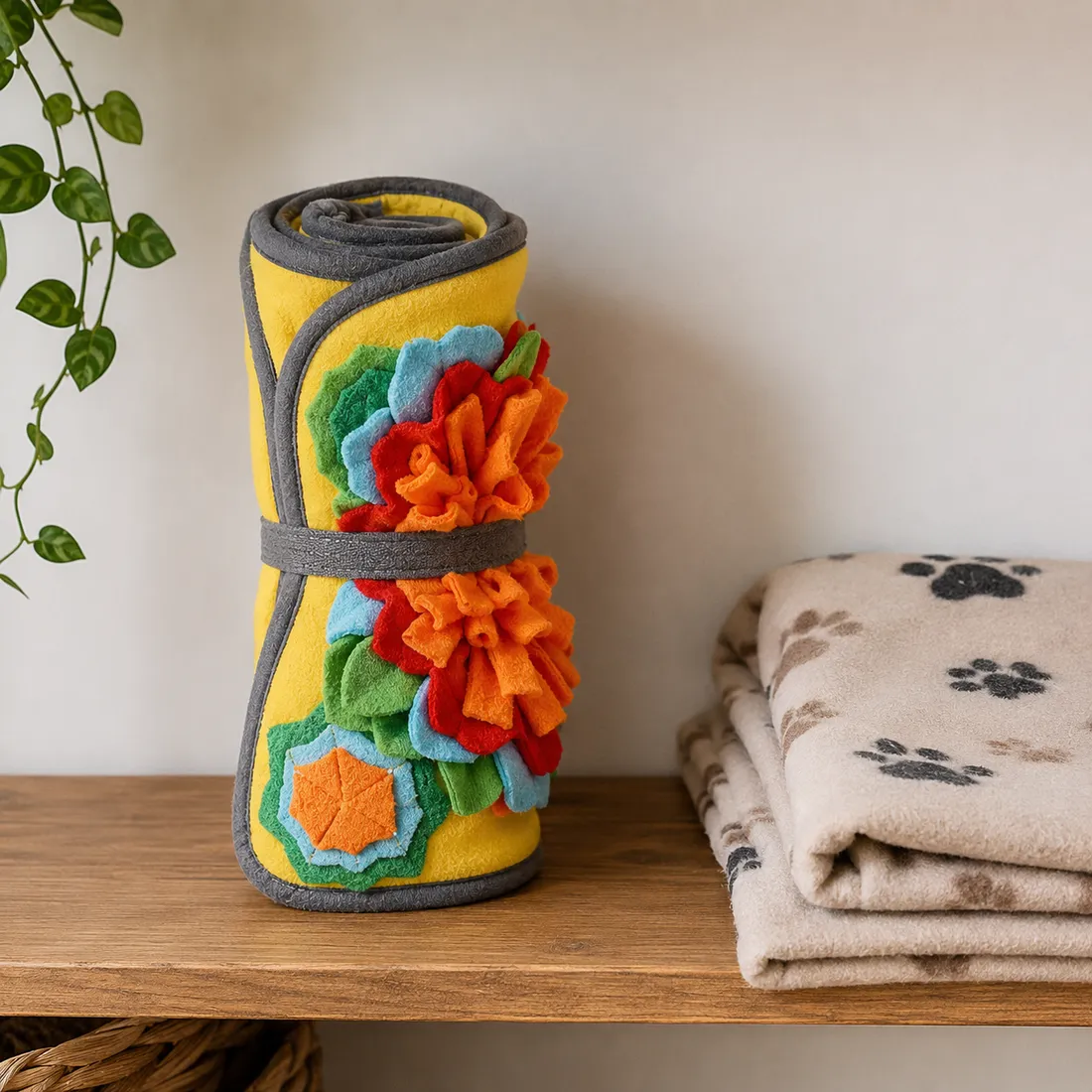
The snuffle mat for dogs that turns dinner into a hunt
Scatter kibble in the shaker-fleece folds and your dog forages nose-first, so a rushed meal becomes ten quiet minutes of sniffing.
🚨 Only a few left in stock
Secure checkout. You can add more packs before you pay.
Mixing colors costs nothing: pick a different colorway for each mat in the pack and your choice travels with the order.
Why nose work is worth the money
A dog's nose is not a rounding error next to ours. Studies of canine olfaction put the gap in the thousands, which is why letting a dog use that sense is so satisfying for them. The point of a snuffle mat is to make that ability the whole game: scatter part of a meal or a handful of treats through the fleece, and the dog has to work zone by zone to find every piece.
scent receptors in a dog's nose, versus about 6 million in a human's, which is why sniffing games are so rewarding
— PBS NOVA, 2012
of US dogs are overweight or obese, so slowing a fast eater with foraging can support portion control
of nose-work games measurably raised pet dogs' optimism in a controlled cognitive-bias study
— Duranton & Horowitz, Applied Animal Behaviour Science, 2019
That controlled study is worth pausing on. Dogs given two weeks of nose-work games approached an ambiguous test faster than dogs given ordinary heel-work, a result researchers read as greater optimism. In plain terms, letting a dog sniff for its food does not just fill time, it appears to nudge mood in a positive direction. That is the real case for buying a good mat rather than the cheapest one.
The five things that separate a good mat from a bad one
1. Surface size and layout
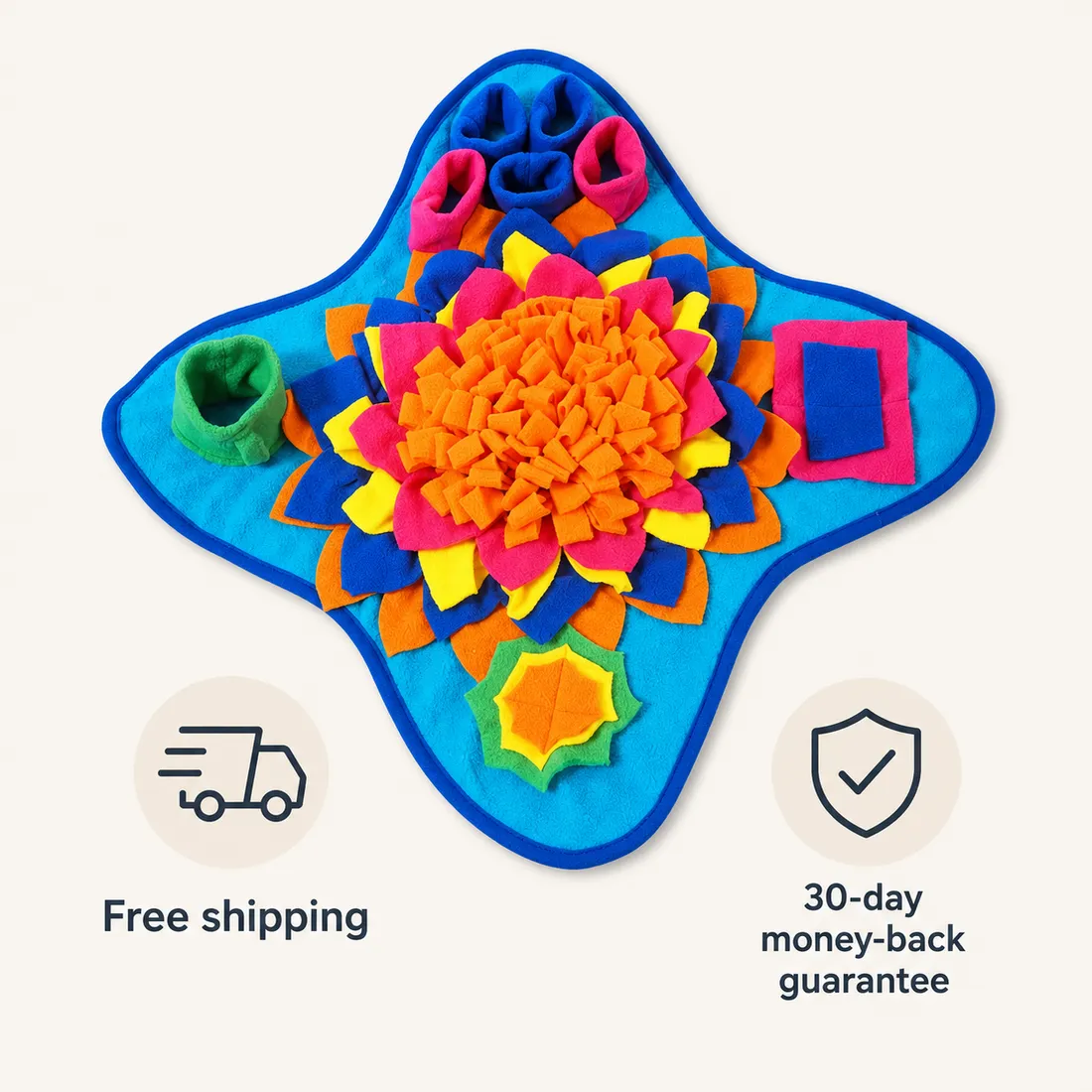
Tiny mats are the most common disappointment. A dog clears a coaster-sized patch in one pass and walks off. Our mat gives a full 19.2 by 19.2 inches of foraging area with a dense central flower plus branch and corner zones, so food can be spread out and genuinely hidden. Bigger dogs get room to work, and small dogs are not overwhelmed because they can start in one corner.
2. Fleece density and pile depth
This is the detail cheap mats cut. Fewer, shorter strips are quicker to sew and use less fabric, but they turn a foraging puzzle into a plate. Shaker fleece with a tight weave of strips and folded petals means your dog has to nudge, dig and nose through layers to earn each reward. Density is also what lets you scale difficulty, tucking food deeper as your dog gets the hang of it.
3. Machine washable
Hygiene is not a nice-to-have with a feeding product. Because the mat touches food and mouths every day, being able to wash the whole thing is the difference between a mat you use for a year and one that ends up in the bin. Ours goes straight in the machine on a cold, gentle cycle, then air dries flat.
4. Non-slip base
You will see this in the review photos our buyers send: dogs plant a paw and drive their nose down into the fleece. That only works if the mat holds its ground. A slippery mat is a frustrating mat, especially for enthusiastic foragers and puppies still learning coordination.
5. Supervision and chew safety
We are direct about this because it is a genuine limit, not a disclaimer. Fabric is soft by design, which is exactly what makes the foraging feel natural, and it is also why the mat needs a watching adult. If your dog is a committed shredder, introduce the mat slowly and never leave it unattended. Our guide to snuffle mats for puppies covers safe introductions in more detail, and it applies to enthusiastic adult chewers too.
What a large dog asks of a snuffle mat
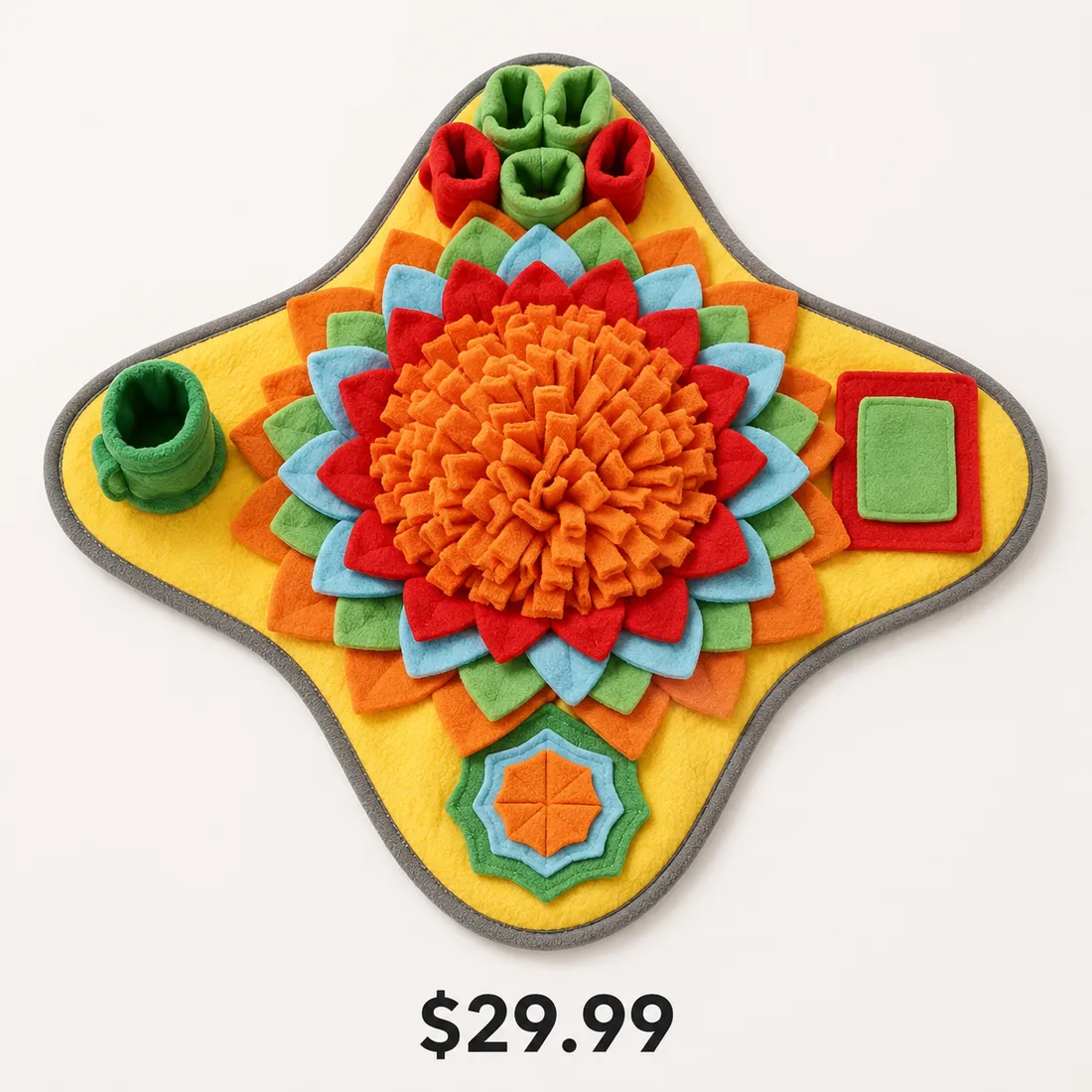
Watch a Labrador or a German shepherd start a session and the difference is immediate. A small dog noses one petal at a time; a large dog can brush several petals with a single swing of its head. Ours answers that with a full 19.2 by 19.2 inches (48 by 48 cm) of foraging area laid out as a four-point star, so there are outer zones, branch folds and a dense central flower to fill rather than one flat patch. Load the corners first and the search stays a search.
The other thing a big dog brings is force: it leans in, plants a paw and drives its nose down through the layers, which is exactly the job the sewn non-slip backing does. Because the shaker fleece strips are layered rather than sparse, a wide muzzle passing over the surface pushes kibble deeper instead of clearing it, and your dog keeps working zone by zone. If you have more than one large forager at home, the 2-pack and 3-pack give each dog its own mat.
Seam strength and what comes out of the wash
A mat that gets fed from every day is a mat that gets washed, and the wash is where flimsy construction shows. Tied-fabric mats loosen knot by knot in the drum, which is why they end up being dabbed at by hand. Ours is stitched: it goes into a cold, gentle cycle, comes out and air dries flat.
Fabric mat vs plastic puzzle vs rubber lick mat
These three enrichment styles get lumped together but reward different behaviors. Here is how they compare by the criteria that matter, kept generic on purpose so you can judge any product you find, not just ours.
| Criteria | Fleece snuffle mat | Rigid plastic puzzle | Rubber lick / treat mat |
|---|---|---|---|
| Main behavior | Sniffing and foraging | Paw and nose manipulation | Licking |
| How mentally tiring | High, taps natural scenting | Medium to high | Low to medium, mostly soothing |
| Machine washable | Yes, full cycle | No, hand wash parts | Usually top-rack or hand wash |
| Noise on hard floors | Silent | Can clatter and slide | Quiet |
| Food types | Dry kibble, treats | Dry kibble, treats | Wet food, pastes, spreads |
| Chew-safety note | Supervise, soft fabric | Supervise, hard plastic can crack | Supervise, chunks can be bitten off |
| Best for | Fast eaters, calm scent work | Problem-solvers who like to shove pieces | Crate settling, vet or bath distraction |
None of these is objectively best, they solve different problems. If your goal is scent-led enrichment, slowing a gulping eater, or giving a restless dog a calm indoor job, the fleece mat is the natural pick. If you want to know more about the category itself, our plain-language explainer on what a snuffle mat is and the evidence-focused piece on whether snuffle mats are good for dogs go deeper.
How the Sniffgrove mat checks the boxes
Against the five criteria above, here is the scorecard.
- Size: a real 19.2 by 19.2 inches (48 by 48 cm) of foraging surface, with a dense central flower plus branch and corner zones so food spreads out.
- Density: shaker fleece with deep, layered strips that actually swallow kibble, so the search lasts and you can scale difficulty.
- Washable: machine washable on a cold, gentle cycle, air dry flat.
- Grip: a base built to stay put so your dog can lean in instead of chasing the mat.
- How to use it: it is a supervised game, not an unattended chew toy.
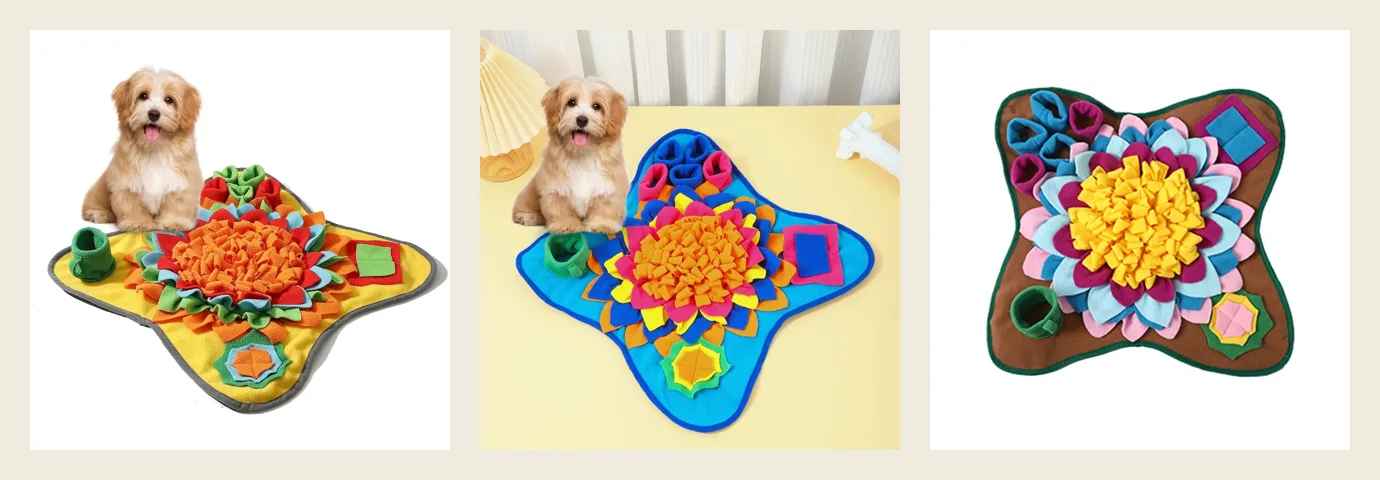
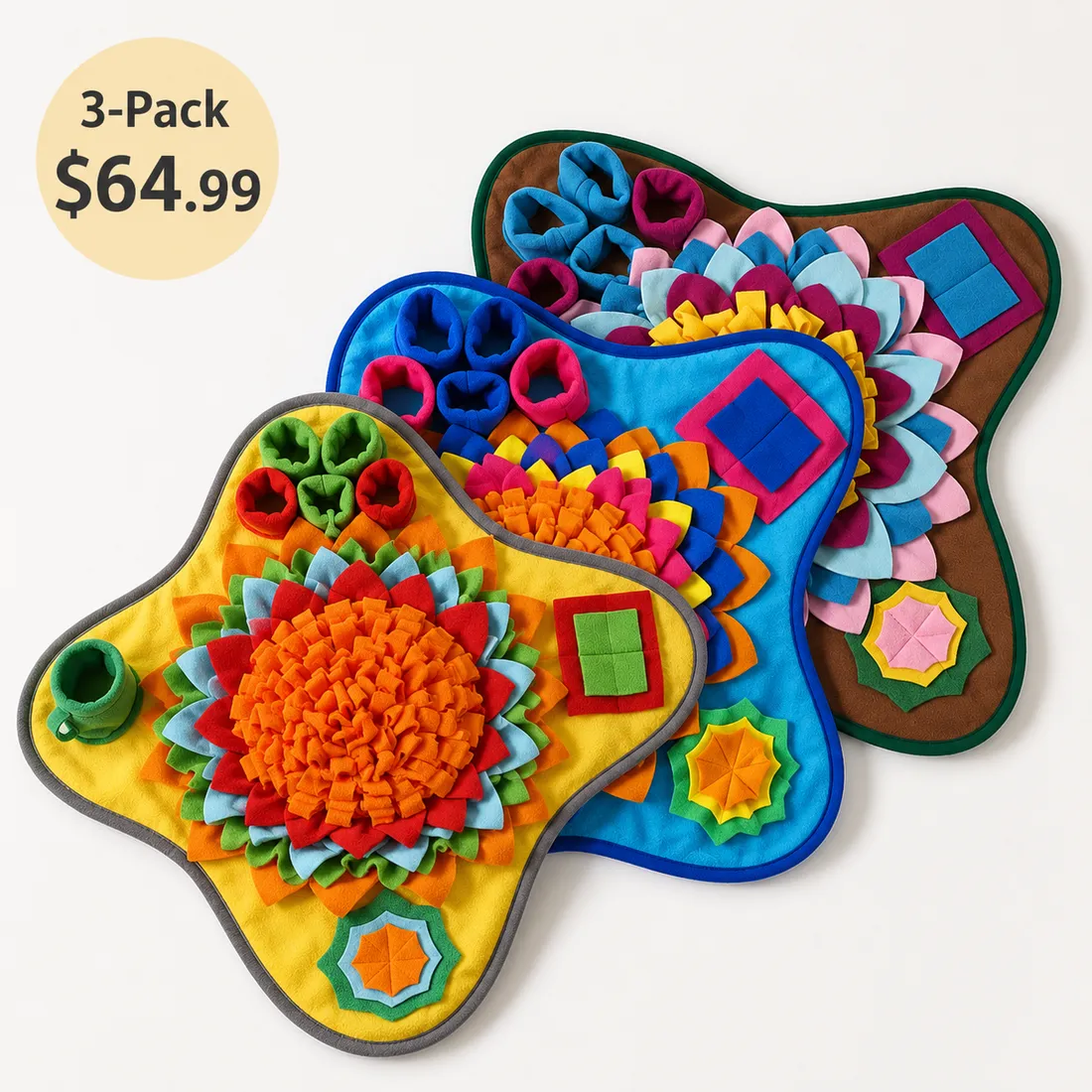
It comes in three colorways, Sunny, Ocean and Earth, and ships free, backed by a 30-day money-back guarantee so the risk sits with us. You can compare colors and see current bundle pricing on the product page, and see verified buyer photos on our reviews page.
Single mat
$29.95 $49.95
Save more on the 2-pack ($49.95) and 3-pack ($64.95).
Free shipping · dispatched in 1-2 business days · 30-day money-back guarantee
Want more nose work in the week? Our dog enrichment ideas build variety around the mat, and the DIY snuffle mat walkthrough explains how the design comes together and why a sewn base survives the washer. Questions are welcome any time through our contact page, and the full terms are on the shipping and refund policy pages.
Snuffle mat buying questions
What size snuffle mat is best for most dogs?
A surface of roughly 18 to 20 inches per side suits most dogs, from small breeds to large ones. It gives enough room to hide food across several zones so the search lasts, while still folding down for washing and storage. Our mat measures 19.2 by 19.2 inches (48 by 48 cm).
Are fabric snuffle mats better than plastic puzzle feeders?
They do different jobs. A fleece snuffle mat rewards natural sniffing and foraging and is quiet and machine washable. A rigid plastic puzzle rewards paw and nose manipulation but can be noisy and cannot go in the wash. For scent-led enrichment, fabric wins.
Can you wash a snuffle mat in a machine?
A good fleece snuffle mat is machine washable on a cold, gentle cycle and air dries flat. This matters because the mat holds food residue and saliva, so being able to clean it fully keeps it hygienic over months of daily use.
Do snuffle mat seams hold up to a strong dog?
Yes, on a sewn mat. The fleece strips are stitched into a sewn base rather than knotted through a loose grid, so they stay anchored while a dog noses and tugs at them, and the same construction is what lets the mat go through a full machine wash.
Does a snuffle mat slide when a large dog pushes into it?
A sewn non-slip base keeps it planted. A big dog plants a paw and drives its nose down through the fleece, so the backing has to grip, and ours is a sewn non-slip backing. That lets your dog lean in and keep searching instead of shoving the mat across the room.
Is a snuffle mat safe to leave a dog alone with?
No. A snuffle mat is a supervised activity, not an unattended chew toy. Most dogs sniff and nudge the fleece, but a determined chewer can pull at strips, so watch every session and put the mat away when foraging time is over.