· By Erin Walsh, Canine Enrichment Trainer
Snuffle Mats for Puppies and Senior Dogs: What to Adjust
Owners of very young and very old dogs ask me the same question from opposite directions. Is foraging too much for a puppy? Is it still worth trying at thirteen? In both cases the activity is right and the setup usually is not, because most snuffle mat advice assumes a healthy adult with good eyes, a full set of teeth and no trouble holding its head down. Most of what follows covers older dogs, since young dogs already have a walk-through on the snuffle mat for puppies page.
What actually changes at each end
Four things drift from the healthy adult baseline: teeth, eyesight, the nose itself, and the ability to hold a head-down posture. Here is what I watch for when I set a mat down in front of either.
| What differs | Puppy | Senior dog |
|---|---|---|
| Teeth | Sharp baby teeth, strong urge to bite and pull fabric | Worn, missing or sore, often with a softer diet |
| Eyesight | Fine, but not yet used for much | Often dimmer, so the nose carries more load |
| Sense of smell | Working well, skill not yet learned | Measurably reduced, still far better than ours |
| Posture | Easy, but tires fast and loses focus | Bending and holding the head down can be sore |
| Main risk | Chewing and swallowing fleece | Giving up, and being read as no longer interested |
The last row matters most. A puppy going wrong is obvious, you can see it chewing. A senior dog just walks away and the owner concludes it has outgrown the game. Usually the mat was set too hard.
How deep to hide the food
It is not that an old dog cannot smell, the margin has narrowed. Researchers ran pet dogs through a scent task in the dark, so vision could not help.
accuracy for senior and geriatric dogs aged 10.8 to 14.8 on a scent-only detection task, against 79.2% for adults aged 2 to 6.5, a significant drop that still sits well above chance
— Khan et al., Scientific Reports, 2023
Read that in both directions. An older dog works with less than it used to, so a mat loaded the way you loaded it five years ago can defeat it. It is also still finding two thirds of the targets on smell alone, in the dark. Nose work is not something a dog ages out of, it is something you turn down.
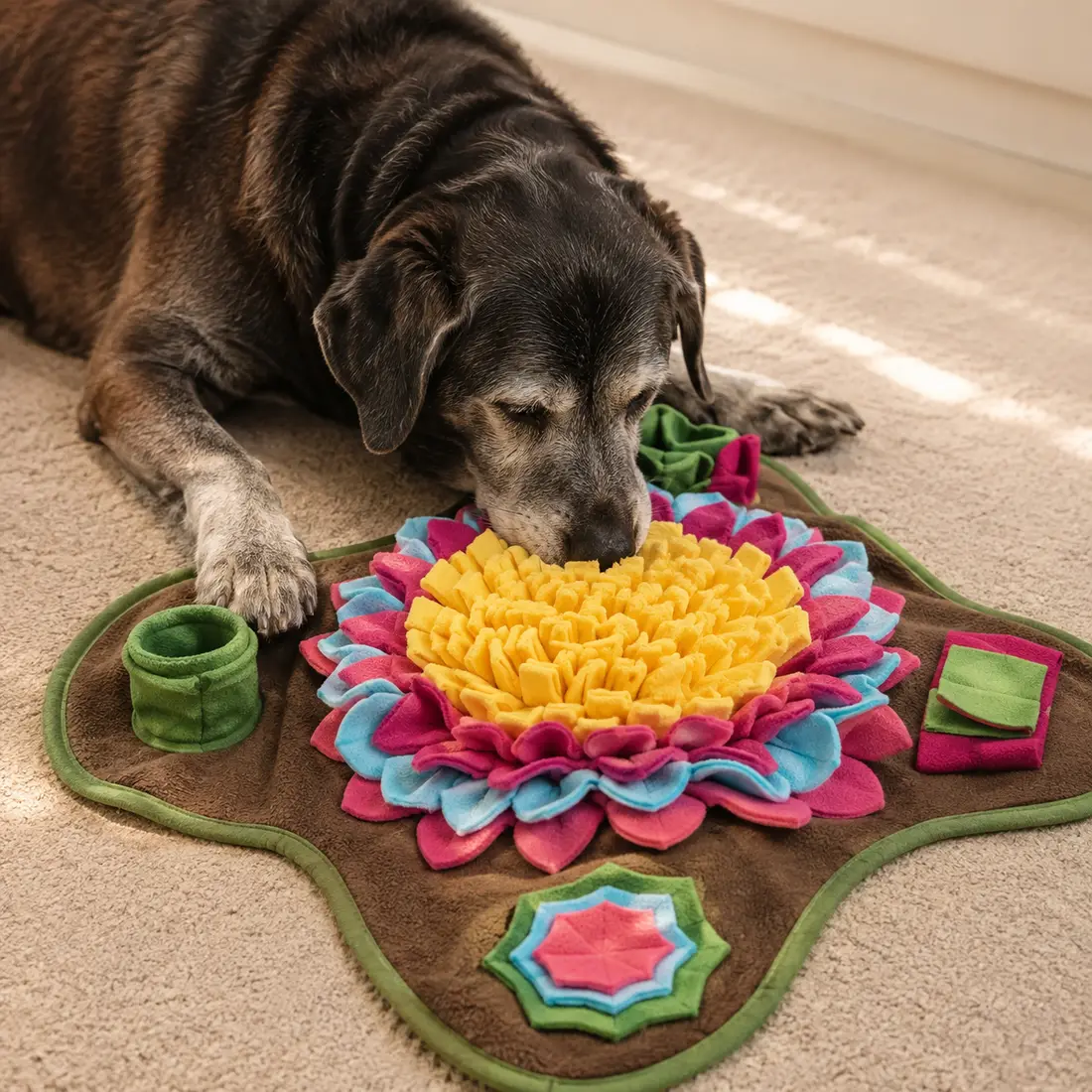
In practice: use the outer petals and flat zones instead of the dense center, reach for something that smells stronger than plain kibble, and resist the urge to tidy food out of sight.
Shorten the session too. The ten to twenty minutes quoted in what is a snuffle mat describes a healthy adult and is a poor target for an old dog, since standing head-down is physical work and concentration fades sooner. Split the meal across two short sessions rather than stretching one.
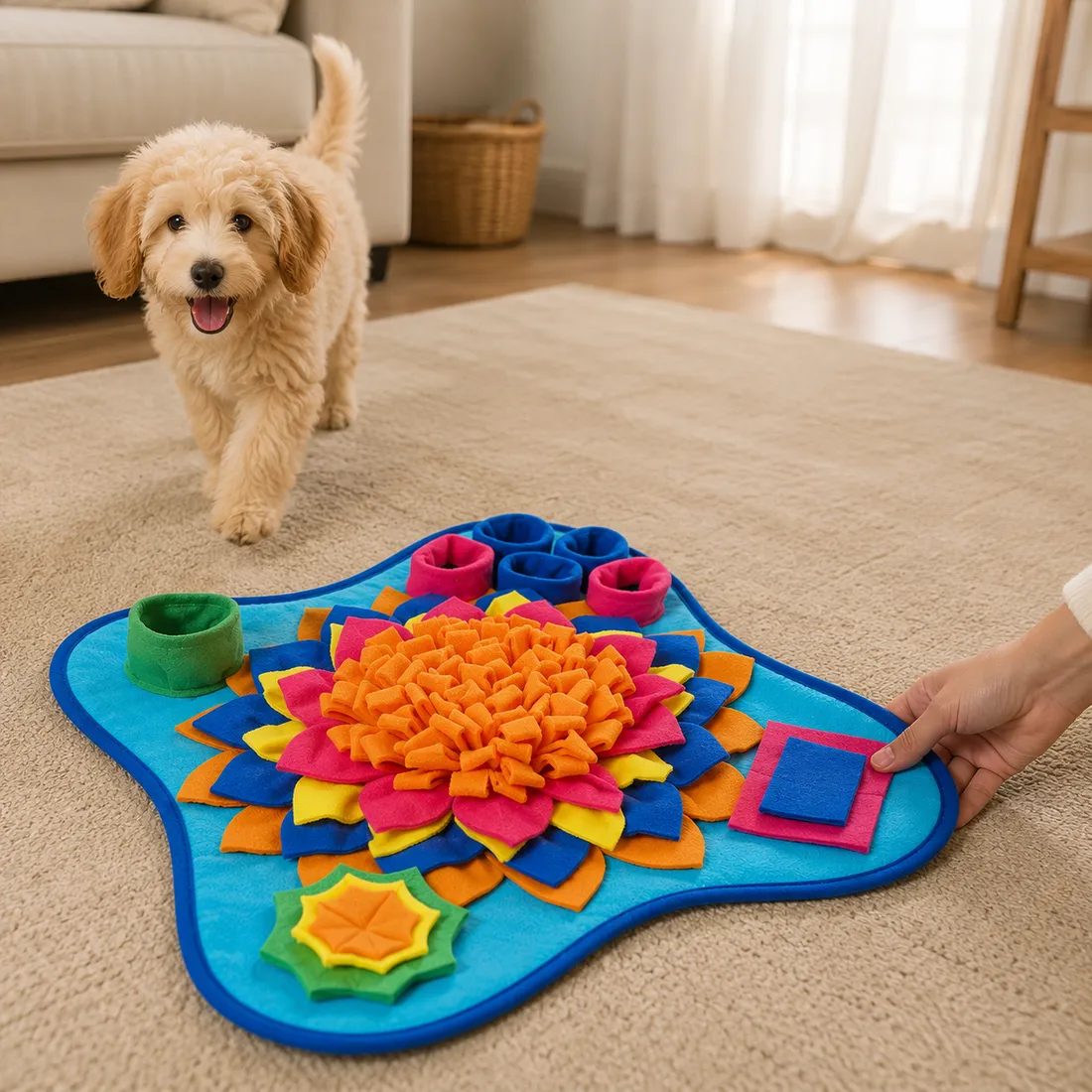
Where to put the mat
median age at first diagnosis of appendicular osteoarthritis across 455,557 dogs under UK primary veterinary care, with dogs over 12 carrying by far the highest odds
I am a trainer, not a vet, so I will not tell you what is happening in your dog's joints. I can tell you what it looks like on a mat. A dog that is sore about bending will hover, lower its head partway, take a few pieces from the near edge, then stand up and stop. It reads exactly like boredom. If that sounds familiar, it is a conversation for your vet, not a reason to buy a different mat.
Two things help meanwhile. Give the mat a surface that holds it still, something one buyer put plainly in a review: "The non-slip backing works well too." And raise the mat on a low step or flat sturdy box if standing over it is the problem. I would not raise it for a dog that is unsteady on its feet, since the trade for a shorter reach is a worse fall.
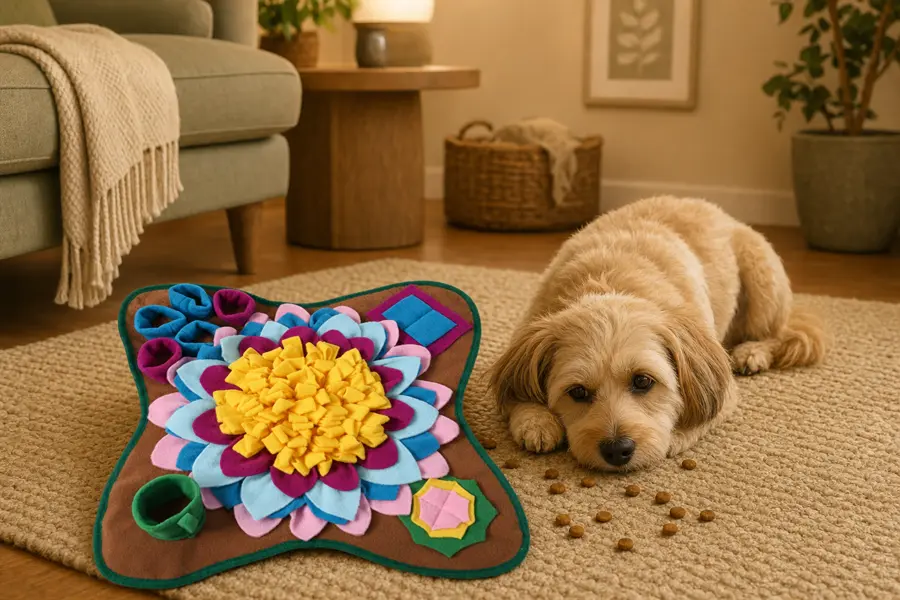
Teeth, and what your dog can eat
This point gets skipped, and it matters most for an older dog. Dental disease and missing teeth are common in senior dogs, and plenty end up on wet food or kibble softened with water. Neither belongs on a fleece mat: it works into the folds, will not come out cleanly for the dog, and turns a machine wash into a chore.
If your dog is on a soft diet, ask your vet whether small dry treats are still safe alongside it and let that answer decide. Some dogs missing a few teeth manage dry pieces well, some should not be given anything hard at all. If the answer is no dry food, this is not the right tool right now, and licking games suit a soft diet better.
When an old dog seems confused
If your dog forgets the game partway through, stands over the mat without starting, or seems lost in a familiar room, that belongs with your vet rather than with a different mat. Cognitive decline in dogs is well documented and becomes more likely with every year.
of dogs aged 15 to 16 showed impairment in at least one of four behavioral categories linked to age-related cognitive decline, against 28% of dogs aged 11 to 12
— Neilson et al., JAVMA, reported in Today's Veterinary Practice, 2001
I will not claim that a snuffle mat prevents or slows any of that, because nobody has tested it. What a mat offers a confused dog is a familiar, low-stakes job with a guaranteed payoff in a room it knows. Keep it in the same spot, keep it easy, and let your vet handle the medical part.
What changes for a puppy
I will keep this short, because the full version already exists. Age to start, first sessions, teething and the move from bowl to mat are covered step by step on the snuffle mat for puppies page. What is worth repeating is supervision. Fleece is soft by design, which is what makes foraging feel natural and also why a determined young dog can work a strip loose and swallow it. Stay in the room, watch for biting rather than sniffing, and put the mat away when the food is gone. The same goes for an enthusiastic old dog, and the reasoning is in are snuffle mats good for dogs.
In a mixed-age household the game travels between dogs. As one buyer put it: "I got it for the puppy, but our adult dog got interested too. Now they dig out the hidden treats together." If you run two dogs on one mat, watch the first few sessions: food on the floor changes how some dogs feel about company.
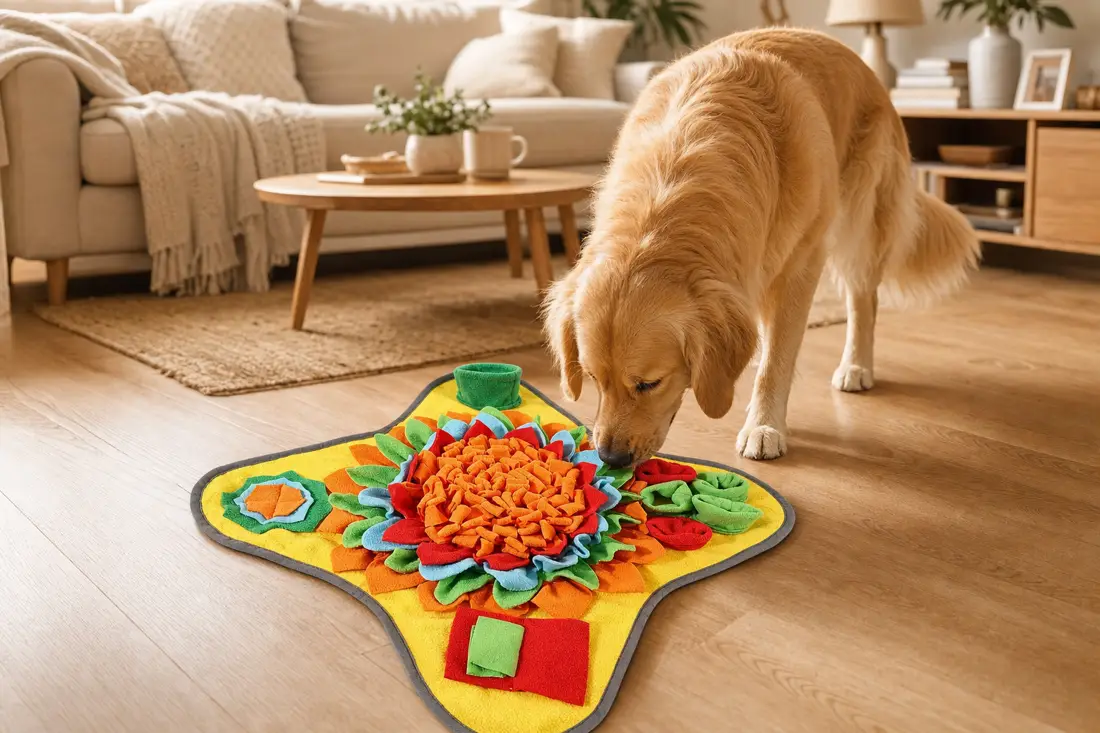
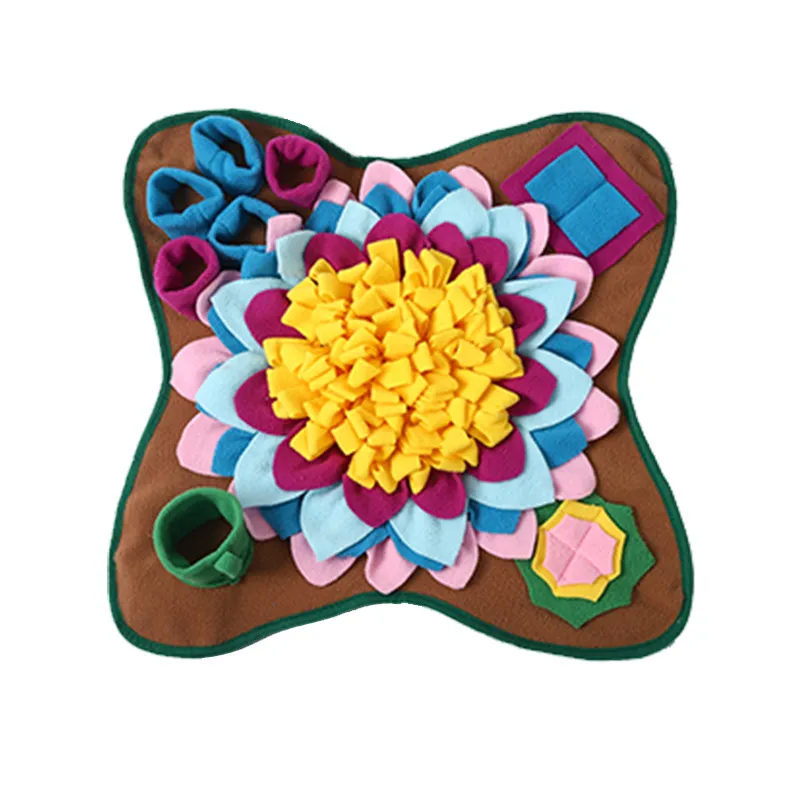
Choosing a mat for an older or younger dog comes down to surface area and fleece density, and the best snuffle mat guide works through all five criteria. Ours measures 19.2 by 19.2 inches with a raised fleece flower and separate corner pockets, so you can keep food shallow for a dog that needs it easy and still hide it deeper later. For other short activities to rotate through the week, see dog enrichment ideas.
Common questions
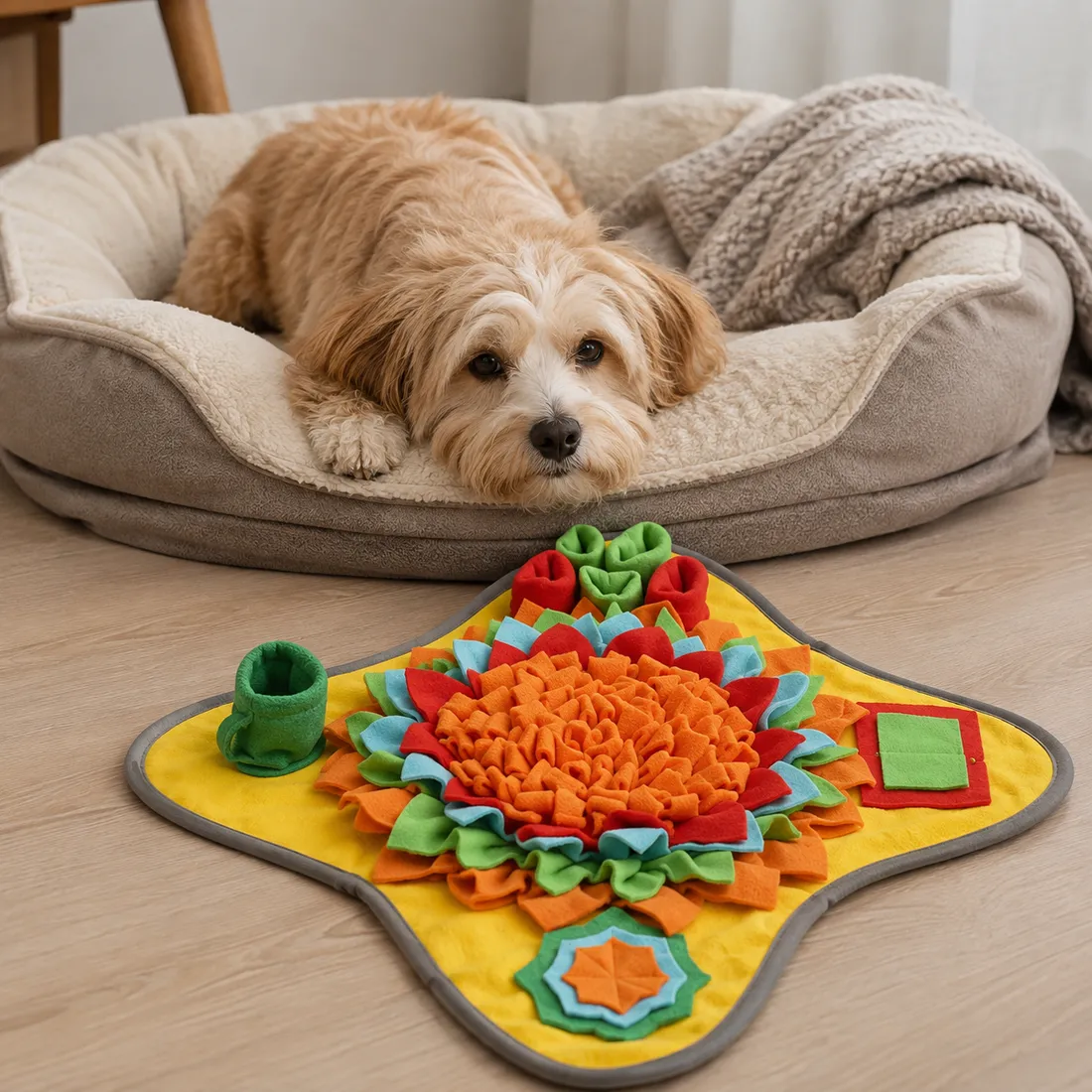
Are snuffle mats good for senior dogs?
Yes, because the work is done by the nose rather than the legs. The adjustment is difficulty, not whether to use one. Keep food nearer the surface, put the mat where your dog can stand comfortably, and let short sessions be enough.
My old dog gives up on the mat. What should I change?
Make it easier before assuming he has lost interest. Scatter food on top of the fleece, use something that smells stronger than dry kibble, and check the mat is not sliding while he pushes at it. A sore dog looks the same as a bored one from across the room.
Can a dog with few teeth use a snuffle mat?
It depends what your dog can pick up and chew. The mat works with dry pieces, so a fully wet or softened diet is a poor match. Ask your vet what your dog can safely eat, then let that answer decide.
Questions about your own dog are welcome through our contact page, and the mat itself is on the Sniffgrove home page.
Machine washable · Free shipping · 30-day guarantee