· By Erin Walsh, Canine Enrichment Trainer
Snuffle Mats and Crate Rest: Occupying a Dog That Has to Stay Still
The message is always the same shape. The walks stopped on a Tuesday, the dog has been told to stay quiet, and by the end of the week nobody is coping. The dog is not sleeping the days away. It is at the crate door at four in the afternoon, looking for what always happened then.
So this is what I set up for a dog whose exercise has been paused, and one line comes before all of it: none of what follows overrides your vet. Where this guide sits at odds with the instructions you were given, the instructions win.
Your vet decides what your dog may do
I am a trainer. I have never examined your dog and I do not know what the rest is protecting, so I am not in a position to tell you that a quiet activity is fine. Nobody writing on the internet is.
What helps is asking in a way your vet can answer. Do not ask whether snuffle mats are allowed, because that is a question about a product. Describe the session instead: my dog standing, or lying down, in one spot, nose in a piece of fleece, for a few minutes, not walking anywhere. That is a description of behavior, and behavior is what a rest instruction is about. Ask at the next check, and write the answer down.
One more boundary, because it matters more here than anywhere else on this site. A snuffle mat is not a rehabilitation device and it does not stand in for anything your vet has prescribed. Recovery belongs to your vet. What a mat addresses is the other problem in the house, the one nobody prescribes for: the empty hours.
Why the days get long when the walks stop
A dog on enforced quiet has not lost its appetite for doing things. It has lost the outlet, and usually the one part of the day it could predict. Owners report the same consequences to me: a dog that pesters, a dog that barks at sounds it used to ignore, a dog that will not settle in the evening.
What is still fully available in that dog is its nose. A movement restriction does not reach it, and it is not a small part of the animal.
larger, proportionally, is the part of a dog's brain devoted to analyzing smells than the equivalent in ours, alongside up to 300 million olfactory receptors in the nose against about six million in a person
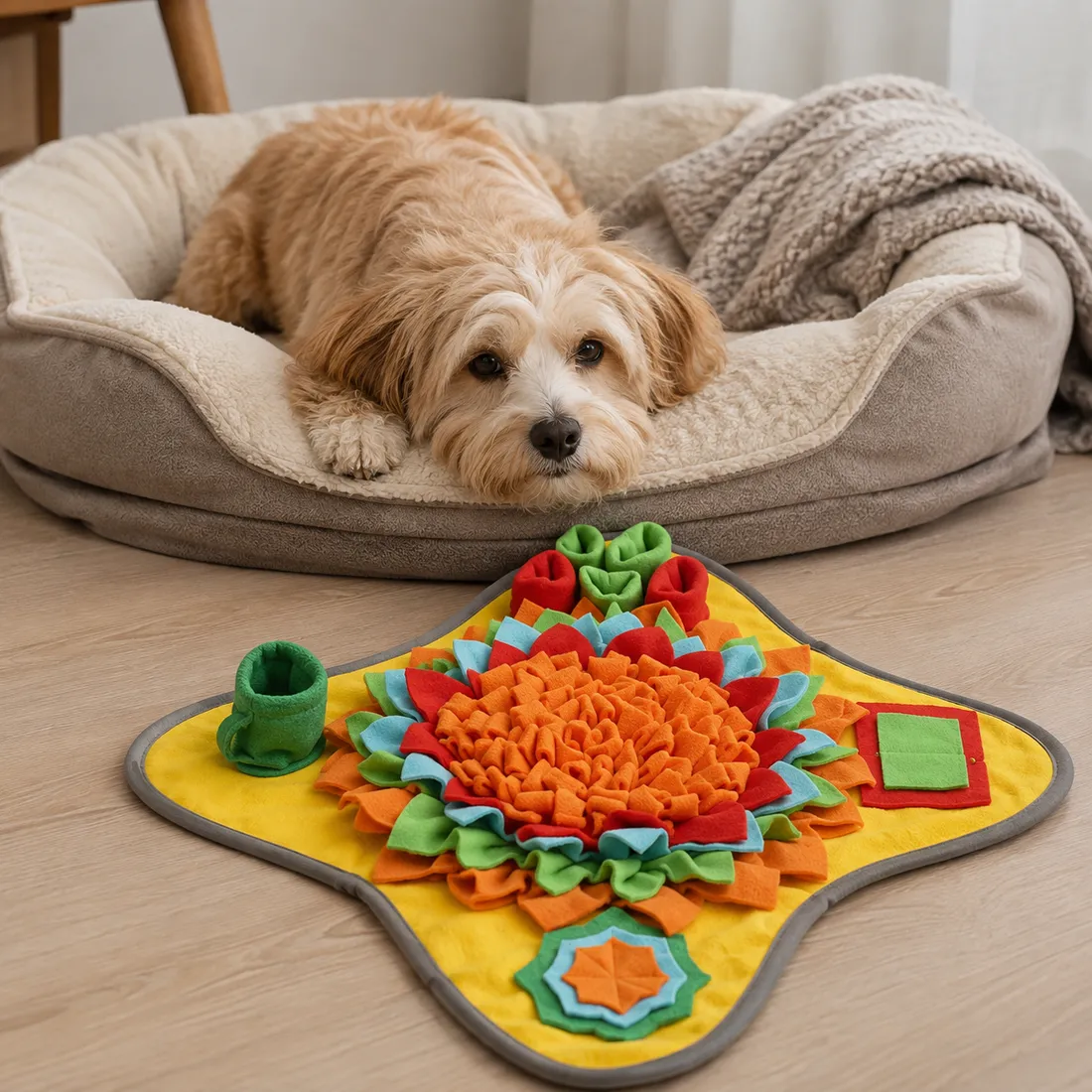
That is the channel a snuffle mat works through. Hiding a meal in dense fleece sets a problem your dog can only solve by sniffing, and it is solved standing or lying in one place. The study trainers reach for tested that kind of time directly.
of daily nose-work left pet dogs quicker to approach an ambiguous stimulus on a cognitive bias test, a shift the comparison group doing heelwork did not show
— Duranton & Horowitz, Applied Animal Behaviour Science, vol. 211, 2019
Read that for what it is. Those were ordinary pet dogs, not dogs on rest, and the study says nothing about recovery, discomfort or healing. What it supports is narrower and still useful: time spent using the nose is time that counts for a dog.
Setting the mat up in or beside the crate
Start with a tape measure. Ours is 19.2 by 19.2 inches (48 by 48 cm) across the four-point star. Measure the floor of your crate. If the mat lies genuinely flat in there with room for your dog, that is the tidiest arrangement, because your dog does not have to go anywhere to reach it. If the edges ride up the sides, do not force it: a mat that curls is a mat that shifts.
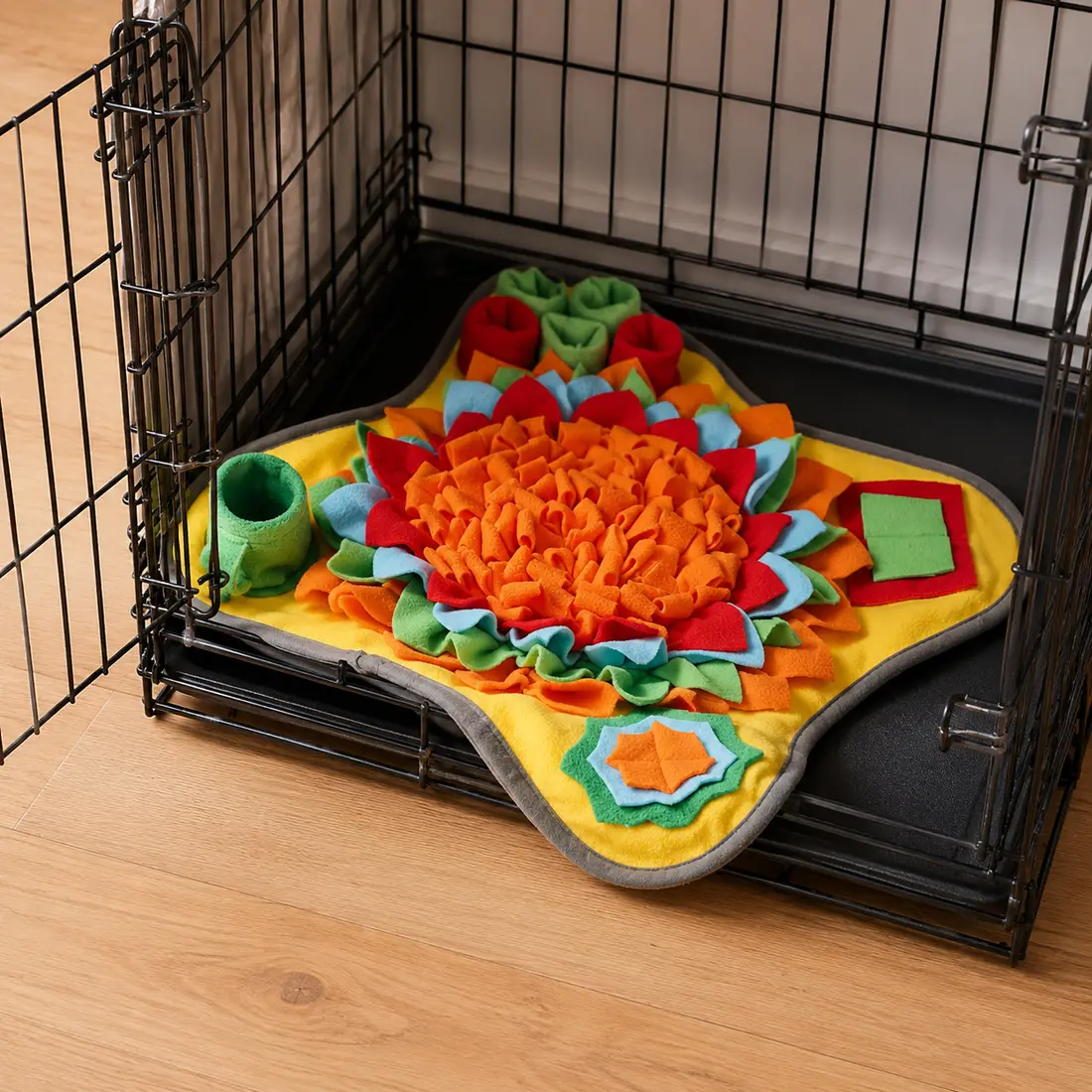
When it does not fit, put it on the floor immediately outside the open door, square to the opening, so your dog can work it from the doorway. Either way the surface underneath matters. Our mat has a sewn non-slip backing, checked on tile, wood and carpet in our testing process, because a mat that skates is a mat the dog chases. That is a nuisance for a healthy dog and something else entirely for one that is meant to be keeping still. Grip is one of the five criteria in the best snuffle mat guide, and here it comes first.
The rule that does not bend is supervision. The mat is never left in the crate as furniture, and it is never bedding. You stay in the room, and when the food is gone the mat comes out. Fleece is soft by design, which is what lets a bored dog work a strip loose. The reasoning is in are snuffle mats good for dogs.
Turning the difficulty down
There are three depths on this mat, and they are the lever: food sitting visibly on the fleece, food pushed down between the petals, food tucked into the rolled corner pockets and the dense flower at the center. The full walk-through is in how to use a snuffle mat. What changes during a period of rest is only which of the three you pick.
Start on top, even with a dog that cleared the deep version easily before. A confined dog usually cannot move around the mat to come at it from a new angle, so pieces it cannot reach from where it stands stay unreachable. If your dog is wearing anything around its head or neck that changes what its muzzle can get to, keep everything on the surface and spread it wide.
Frustration is the thing to design out. A dog that hits a wall does not decide the mat is difficult, it decides the mat is finished. Give away the first few sessions: easy, quick, obviously solvable. You can press the food deeper next week. If your dog is older as well as resting, the adjustments stack, and they are in snuffle mats for puppies and senior dogs.
Feeding the ration through the mat
That order is deliberate. The amount of food a resting dog should have is a veterinary question, precisely because the activity has changed. Ask, get the amount, then treat what follows as a way of serving it.
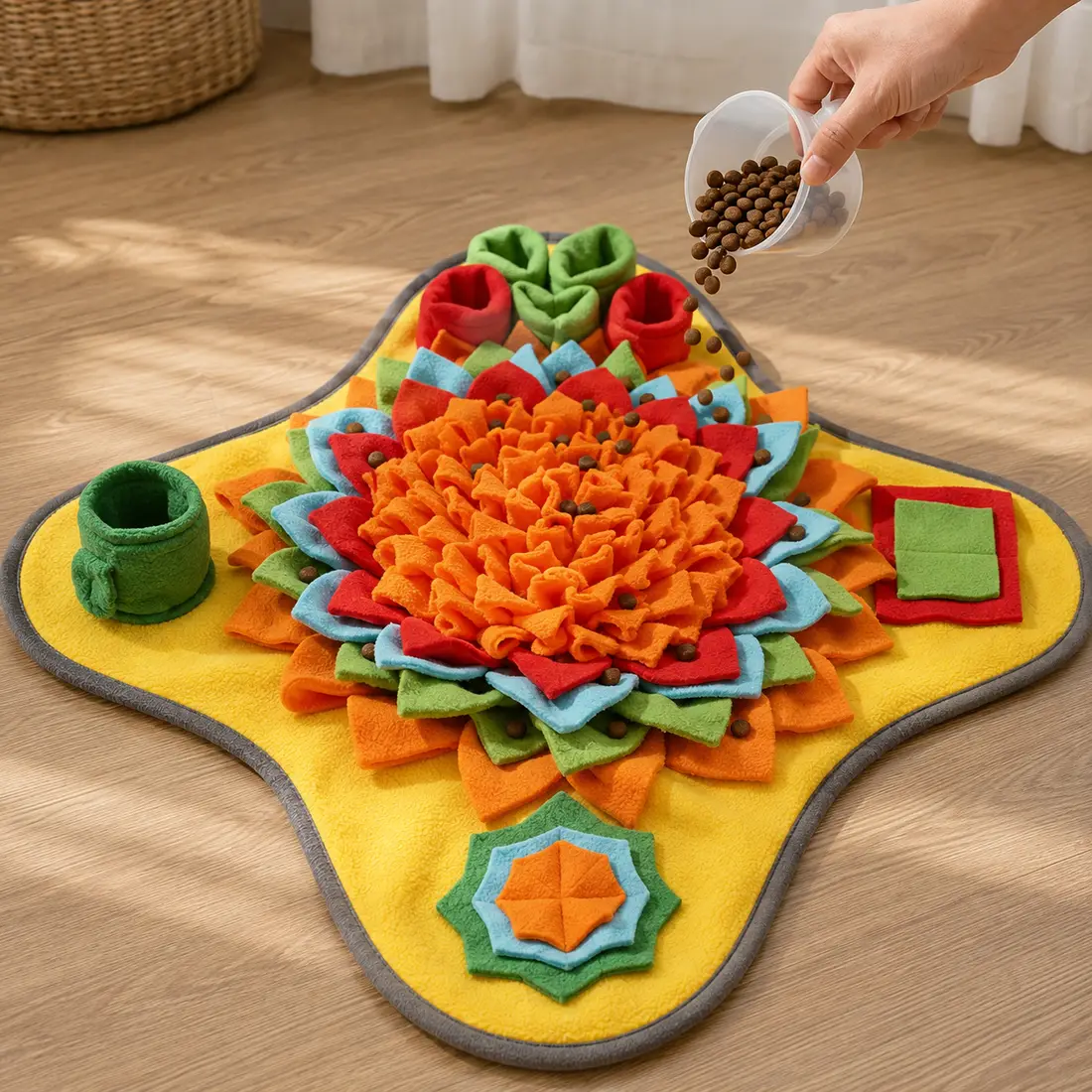
Serving it through the mat turns one item on the schedule into two. A meal in a bowl is over in under a minute and leaves the afternoon exactly where it was. The same meal spread across the fleece has to be found piece by piece, and becomes an event with a beginning and an end. Split the day's food across two mat sessions and you have two events, without adding a single piece of kibble.
What goes in is unchanged by the rest: dry, small and firm, and the kibble your dog already eats is the obvious candidate. Wet food and kibble softened with water work into the fleece instead of hiding in it. The full table of what belongs in and what stays out is on the how to use a snuffle mat page.
One knock-on effect. A mat carrying meals twice a day goes through the machine more often: gentle cycle, mild detergent, no fabric softener so the fleece keeps its grip, air-dry. With a second mat one is drying while the other is working, which is what our 2-pack and 3-pack do for a single dog on rest.
Owners who use the mat mainly to fill time say much the same about it. One buyer: "Really lovely. My dog loves it and it keeps him busy because there is so much to nudge and pull at." More on the reviews page.
What to watch while your dog works
Two things are being observed here. The first is the session, which ends when your dog stops searching rather than when the fleece is empty. A dog that switches from sniffing to tugging has finished. A dog that lifts its head and keeps it up has run out of concentration. A dog that walks off, comes back and walks off again is checking rather than working. Any of those is a full stop: shake the rest of the food out, give it in the bowl so the meal is still the meal, and put the mat away. The complete list of end-of-session signals is in how to use a snuffle mat.
The second is everything that is not about the mat. If your dog holds itself differently than it did yesterday, will not put its head down, shifts its weight oddly, gets up in a way it did not before, or anything strikes you as new, that goes to your vet the same day. It does not go to a shallower load or a shorter session. I can tell you what a dog looks like when a game has got too hard; I cannot tell you what it means when a dog on rest changes how it stands.
Common questions
Can I leave the snuffle mat in the crate with my dog?
No. A snuffle mat is a supervised activity from start to finish, and that does not change because your dog is confined. The mat goes in for the session, you stay in the room, and it comes out when the food is gone. A dog with fleece in front of it and nothing left to find is a dog with time on its hands.
My vet said no exercise. Does a snuffle mat count as exercise?
That is a question for the person who set the rest, and only that person can answer it for your dog. Describe the session rather than the product: your dog standing or lying in one place with its nose in a piece of fleece, for a few minutes, without walking anywhere. Then follow the answer you are given.
How much of the meal should go on the mat while my dog is resting?
How much your dog should be eating while it is not exercising is a conversation with your vet, not something to work out from an article. Once you have that amount, the mat can carry part or all of it, so the activity comes out of the food your dog is already getting rather than on top of it.
New to the idea? The what is a snuffle mat explainer covers the mechanics, and the mat itself, in all three colorways, is on the Sniffgrove home page.
Machine washable · Non-slip sewn base · Free shipping