· By Erin Walsh, Canine Enrichment Trainer
How to Use a Snuffle Mat: A Step-by-Step Guide
Most snuffle mat problems that land in my inbox are loading problems. The owner has either buried a full dinner in the fleece on day one and watched a confused dog give up, or left the mat on the floor until it became a chew toy. Both come from the same gap: nobody explains what a first session should look like.
So this is the walk-through I give owners in person: the first session, the portion, the difficulty, when to stop, supervision, what belongs in the fleece, and what to do with the mat between meals. If you are new to the idea, start with what is a snuffle mat, which also gives the session length that suits a typical adult dog.
The first session: show the food
Owners want to make it a puzzle straight away, because a puzzle is the point. But a dog fed only from a bowl has no reason to believe there is food inside a piece of fleece. The first session is a demonstration, not a test.
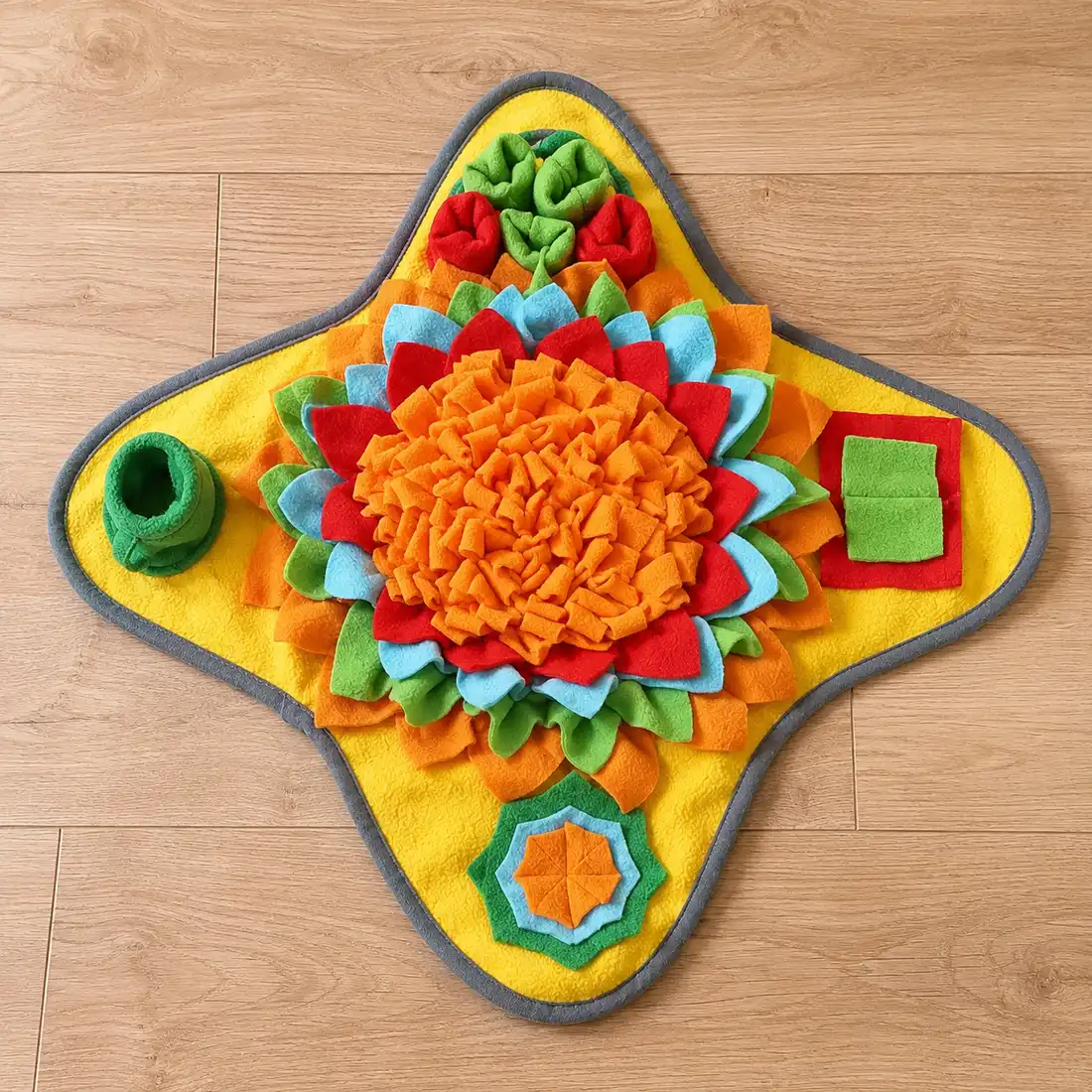
Mat flat on the floor, dog in the room and interested. Take a handful from the measured portion and drop it onto the surface in plain sight, while your dog watches. Let it eat. Drop a second handful the same way, letting a few pieces fall between the petals so the dog has to nose one layer aside. That is the whole first session.
One thing I would not do: move the mat while the dog is working. A mat that slides under a dog's nose is one the dog stops trusting, which is why a base that grips matters.
How much food goes in
This is the most common mistake, and an easy one to make. The mat is fun, so it gets used as a treat activity in the afternoon while breakfast and dinner carry on as normal. That is a third meal wearing a costume.
of US dogs are overweight or obese, which is why enrichment is worth serving out of the existing ration rather than on top of it
So decide which meal the mat replaces before you fill it. One meal a day on the mat and the rest in the bowl keeps the game special and the maths simple. While your dog is learning, split that meal: a quarter of the portion on the mat, the remainder in the bowl afterwards, then shift the balance across as your dog gets confident. Fractions of the ration, not handfuls, is what stops the portion drifting upward.
Training treats come out of the same daily total. One buyer: "I bought this because my puppy was eating way too fast, and now he happily searches out his food." More on the reviews page.
Making the search harder
Once your dog clears a surface scatter without hesitating, you have room to move. Think of the mat as three levels rather than one:
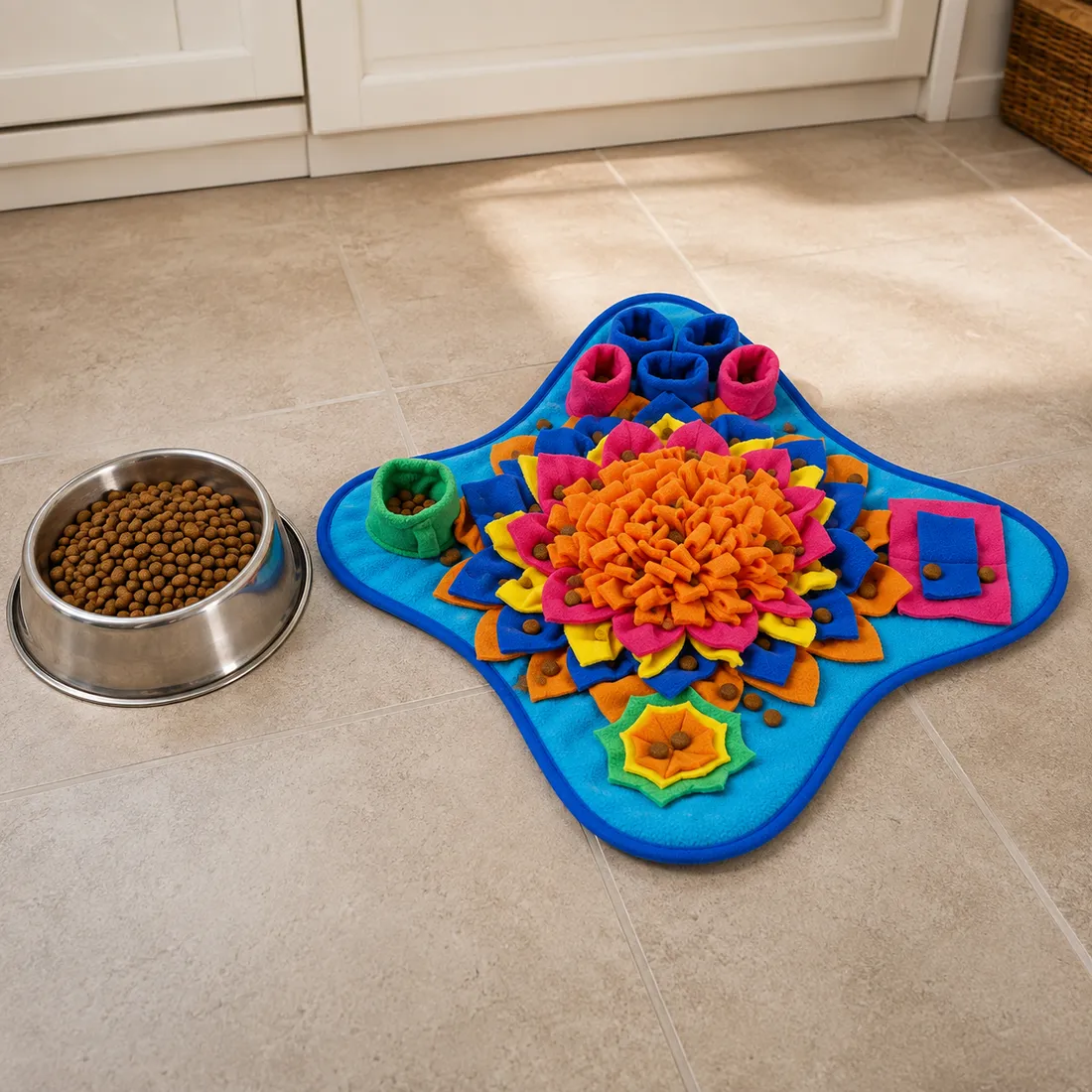
- On top. Food sits visibly on the fleece. This is the first-session level, and it stays useful as a warm-up or for a dog that is tired.
- In the folds. Push pieces down between the petals so nothing is visible from standing height. The dog now works by scent rather than sight.
- In the pockets. Tuck food into the rolled corner pockets, under the flap patches, and deep into the dense flower at the center. This is the hardest the mat gets.
Move up a level only when the current one has stopped being interesting. A dog that hits a wall too early does not conclude the mat is difficult, it concludes it is not worth the effort, and that is harder to undo than it was to create. Give it a couple of weeks before you judge; the study most cited on nose-work ran on that timescale.
of regular nose-work games left pet dogs measurably more optimistic on a cognitive bias test, while a comparison group doing heelwork did not shift
— Duranton & Horowitz, Applied Animal Behaviour Science, vol. 211, 2019
Harder is not automatically better, and for some dogs the right setting is permanently level one. Older dogs often need the food kept near the surface, and the reasons, along with what changes for a very young dog, are in snuffle mats for puppies and senior dogs.
How long a session runs, and how to end it
Owners ask me for a number, and the number depends on how you loaded it: the same portion pressed deep lasts several times longer than one scattered on top. What is more useful day to day is knowing what the end of a session looks like, and none of these signals need a clock:
- The searching stops and the pulling starts. A dog that has switched from sniffing the fleece to tugging at it with its teeth has finished foraging. End there, every time.
- The dog walks off, comes back, walks off again. That is a dog checking whether anything is left. Usually there is not.
- The head comes up and stays up. Head-down searching is physical work, so a dog that keeps lifting out of it has run out of concentration before it ran out of food.
- Frustration noises. Whining or pawing at the mat means the level is too hard. Make the next session easier rather than pushing through this one.
If your dog stops with food still in the fleece, shake the remainder out and give it in the bowl, so the meal is still the meal. Then put the mat away: ending while the dog is still enjoying it keeps the next session eager.
Why the mat is never left out
This is the one point I will not soften. A snuffle mat is an activity you do with your dog present. The risk is not that the mat is fragile; it is that a bored dog with fabric in front of it and no food left in it will eventually start chewing, and swallowed fabric is a genuine problem.
Being in the room also means you see the switch from nose to teeth, the dog that guards the mat when another animal walks past, and the dog that has had enough. None of that reaches you from the next room.
The safety reasoning is set out in are snuffle mats good for dogs, and puppies get their own supervision rules on the snuffle mat for puppies page, because a young dog explores with its mouth by default.
What goes in, and what stays out
| Goes in | Stays out |
|---|---|
| Your dog's normal dry kibble, straight from the measured portion | Wet food, or kibble softened with water, which works into the fleece instead of hiding in it |
| Small dry training treats, counted into the daily total | Oily or greasy treats that leave a residue in the fabric |
| Freeze-dried pieces, when you want a stronger smell than plain kibble | Anything a fast dog would swallow whole without chewing |
Two notes. Strong-smelling food makes the mat easier, not harder, a lever worth remembering for a dog that has lost interest. And piece size matters: large pieces sit on top of the fleece, small ones fall deep into it, so a mix gives an easy start and a hard finish in one load.
Wet food is the one I get argued with about: a smeared mat gives the dog nothing to find, and it turns a machine wash into a chore. If your dog is on a soft diet, licking games suit it better.
Between two sessions
The routine takes seconds. Lift the mat by two corners over a bin or outside, shake it hard, and run your fingers through the flower to dislodge what is caught in the center. Then roll it rather than folding it flat: standing fleece is what holds food deep on the next load.
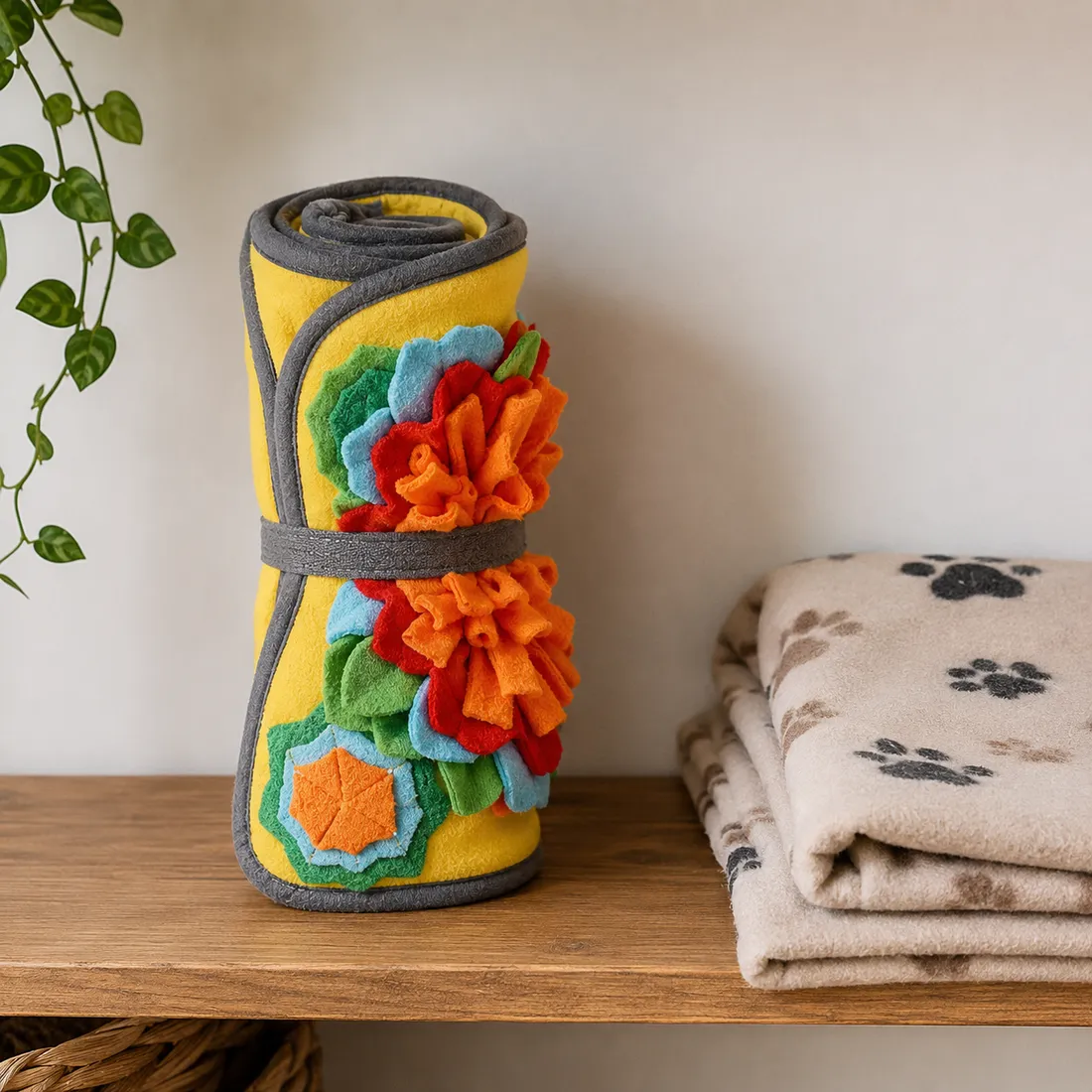
Store it up off the ground, on a shelf or in a cupboard with the rest of your dog's things. Rolled and strapped, it takes about as much room as a folded blanket.
Wash it when it needs it, and let it dry completely, because damp fleece mats together and stops holding food. Ours is machine washable.
If you run more than one dog, give each its own mat and its own spot until you know how they behave with food on the floor. Surface area and fleece density decide how much a mat can hide, and the best snuffle mat guide works through both.
Common questions
Can I leave a snuffle mat down all day?
No. A snuffle mat is a supervised activity, not a leave-out toy. Once the food is gone there is nothing left to find, and a mat left on the floor stops being interesting and starts being something to chew. Pick it up when the session ends and bring it back at the next meal.
What can I put in a snuffle mat besides kibble?
Anything dry, small and firm enough for your dog to pick out of the fleece: the kibble your dog already eats, small dry training treats, or freeze-dried pieces when you want a stronger smell. Keep wet food, oily treats and anything that smears out of the fabric.
My dog empties the mat in seconds. What should I change?
Load it differently rather than loading it fuller. Push the food down into the dense center instead of scattering it on the surface, tuck pieces into the corner pockets and under the flaps, and keep the same amount of food. Difficulty comes from depth, not quantity.
Machine washable · Free shipping · 30-day guarantee